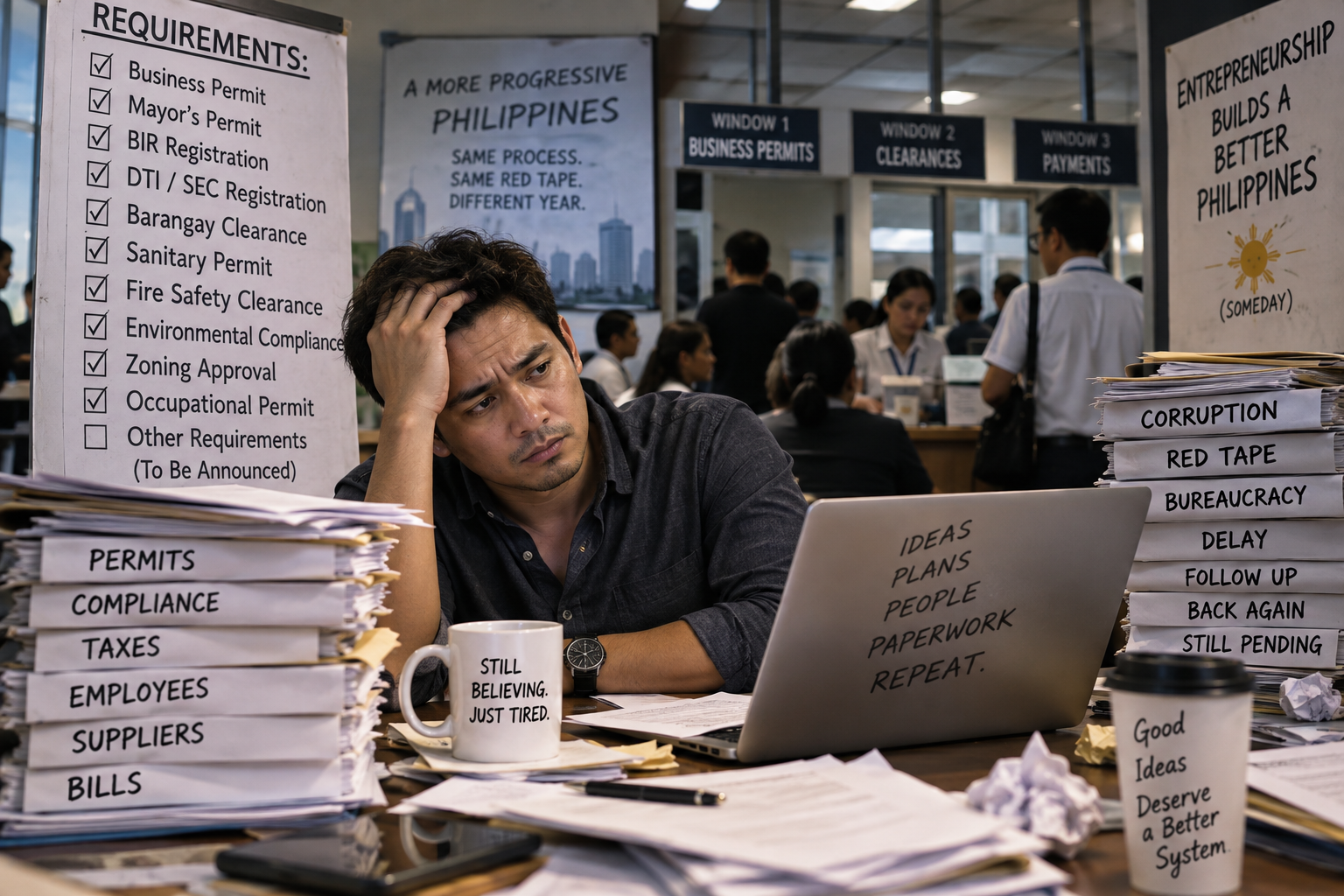
I've spent years encouraging Filipinos to become entrepreneurs. Given where we are today, I'm no longer sure that's responsible advice.
For years, I have been an advocate of entrepreneurship, home-based employment, freelancing, and creating opportunities for Filipinos. I have always believed that Filipinos should not have to leave the country just to build a better life. Technology opened opportunities that previous generations never had. A Filipino sitting at home with a computer and a decent internet connection can work for an international company, serve clients halfway around the world, build a digital business, and eventually employ other Filipinos.
I still believe in all of that. What has changed is my willingness to automatically tell someone, "Go start a business."
Today, if a young Filipino with a decent job and some hard-earned savings asked me whether they should resign and put everything into a startup, my answer would probably surprise them: don't. At least, not right now.
It feels strange writing that because it contradicts so much of what I have advocated for over the years. But experience has a way of replacing motivational quotes with spreadsheets, payroll deadlines, tax filings, government permits, employee problems, and the occasional existential crisis over a cup of coffee.
Entrepreneurship is supposed to involve risk. What bothers me is how much unnecessary risk we have added on top of it.
Business Is Already Hard. Why Make It Harder?
Starting a company is difficult anywhere. You have to find customers, manage cash flow, hire people, compete with established companies, negotiate with suppliers, market your products, collect payments, and somehow make sure there is enough money left at the end of the month to continue doing it all over again.
I accept those problems. They are part of business. If my product is terrible, customers shouldn't buy it. If I manage the company badly, competitors should beat me. If I make stupid financial decisions, the market has every right to teach me an expensive lesson.
What becomes frustrating is when entrepreneurs have to fight the system in addition to fighting for customers.
Anyone who has operated a business in the Philippines knows the routine: registrations, permits, clearances, renewals, taxes, compliance requirements, supporting documents, photocopies, signatures, and trips between offices. Things have improved in some areas, particularly as more government services move online, and those improvements should be acknowledged. But there remains a considerable difference between announcing that a process has been streamlined and being the business owner actually trying to complete it.
Sometimes the experience feels like a government-designed escape room. Office A tells you to obtain something from Office B. Office B says you first need approval from Office C. Office C asks for a document you already submitted to Office A. Eventually you return to Office A holding a folder thick enough to qualify as construction material.
Your prize for completing the challenge is not money, a trophy, or even a free ballpen. Your prize is permission to continue operating the business that will eventually pay taxes to the same system.
Corruption Has a Cost Beyond the Money
Then we come to the subject nobody particularly enjoys discussing: corruption.
Corruption hurts businesses in ways that go beyond whatever amount of public money may be lost. It weakens confidence in institutions and creates uncertainty about whether the same rules apply equally to everyone. Business owners can work with strict rules. We can budget for taxes, prepare for deadlines, comply with regulations, and adjust our operations to clear requirements.
What is much harder to work with is unpredictability.
Businesses need to know that if they follow the rules, submit the requirements, pay the correct fees, and comply with the law, the system will work as expected. When procedures become unnecessarily complicated, enforcement appears inconsistent, or personal connections seem more useful than understanding the actual process, confidence suffers.
That matters because entrepreneurs make decisions based on confidence. We invest money today because we believe there will be an opportunity tomorrow. We hire someone because we believe revenue will continue. We sign leases, buy equipment, develop products, and take loans based partly on our confidence that the environment in which we operate will remain reasonably predictable.
When that confidence disappears, investment eventually follows it.
And Then You Discover That Managing People Is a Business of Its Own
Government bureaucracy isn't the only thing that can exhaust a business owner. There is another subject entrepreneurs don't always discuss publicly because it can quickly be misunderstood: managing employees in the Philippines can be incredibly difficult.
I want to qualify that statement because I have worked with excellent Filipino employees. I have met people who are intelligent, loyal, resourceful, hardworking, and willing to take responsibility far beyond what their job description requires. When you find employees like that, you quickly understand that good people are among the most valuable assets a company can have. Pay them fairly, help them grow, listen to them, and do your best to keep them.
But anyone who has managed people for a significant amount of time also knows the other side of the story. Attendance problems, unexplained absences, employees disappearing after payday, poor communication, avoiding responsibility, repeated excuses, and having to follow up on tasks that should not require constant supervision can slowly drain the energy out of a small business owner.
One of the biggest challenges is developing a genuine sense of ownership. I don't mean employees should behave as if they literally own the company or work unpaid overtime because somebody put "We Are Family" on the office wall. They don't own the business, and employers shouldn't pretend they do whenever it is convenient. I mean professional ownership: if something is your responsibility, take responsibility for it. If there is a problem, communicate it. If you made a mistake, acknowledge it. If you don't understand something, ask.
Those behaviors sound basic until you have managed a team and discovered how valuable they actually are.
This isn't uniquely a Filipino problem, nor is every Filipino employee like this. Poor management can also create poor employees. Companies that underpay people, provide no opportunities, tolerate incompetent managers, and treat staff badly shouldn't be surprised when employees stop caring. Employment is a two-way relationship, and employers have responsibilities too.
Still, for a small entrepreneur, one or two bad hires can cause enormous damage. A multinational corporation can absorb hiring mistakes. A company with six employees cannot. If two people suddenly disappear, you haven't lost a tiny percentage of your workforce. You've lost one-third of the company.
At that point you're no longer the CEO. You're the CEO, HR department, recruiter, operations manager, customer service representative, and possibly the person cleaning the office because everyone else called in sick.
The Employee and Entrepreneur Experience Risk Very Differently
One thing I wish more aspiring entrepreneurs understood is the difference between receiving a salary and creating the money required to pay that salary.
Employees should expect to be paid correctly and on time. That is the employer's responsibility. But the employee usually doesn't see everything that happens before payroll arrives. Customers may be late paying invoices. Sales may have fallen. Equipment may have broken. A major client may have left. Rent may have increased. The government still expects its payments, suppliers want theirs, and employees understandably expect their salaries.
The entrepreneur sits between all of those obligations.
This is also why revenue can be deceptive. People sometimes hear that a company generates millions of pesos in revenue and imagine the owner swimming through a vault of money like Scrooge McDuck. In reality, revenue enters the company's bank account and immediately gets attacked by payroll, taxes, rent, utilities, suppliers, benefits, software subscriptions, equipment, professional fees, marketing, and expenses nobody warned you existed when you watched that inspirational entrepreneurship video on YouTube.
Whatever survives the attack is called profit.
Sometimes there are no survivors.
Maybe Being an Employee Isn't Such a Bad Deal
This brings me to the uncomfortable conclusion that inspired this article.
We have romanticized entrepreneurship too much.
Social media has created an image of entrepreneurship consisting mainly of laptops, coffee shops, cars, airport lounges, inspirational quotations, and people explaining how they "escaped the 9-to-5." What doesn't photograph quite as nicely is an entrepreneur staring at payroll at two in the morning wondering why several customers who promised to pay on Friday have suddenly stopped answering their phones.
There is nothing wrong with employment. In fact, becoming an exceptional employee may currently be one of the smartest economic decisions a young Filipino can make.
Become extremely good at something valuable. Learn technology, AI, sales, marketing, finance, engineering, design, operations, management, or whatever field suits your abilities. Work for good companies. Build international experience. Work remotely if the opportunity exists. Earn from the global economy. Develop your professional network, save money, invest, and increase the value of your skills.
More importantly, become the kind of employee every entrepreneur desperately wants to find: someone reliable, accountable, curious, professional, and capable of solving problems without needing to be chased around the office.
A good employee who earns well, saves money, invests, supports a family, develops valuable skills, and sleeps peacefully on Sunday night is not somehow less successful than somebody who changed their LinkedIn title to "Founder & CEO."
Sometimes the employee is actually making more money than the CEO.
And sleeping better.
We Need to Stop Treating Resilience as an Economic Policy
Filipinos love talking about resilience. Whenever there is a crisis, natural disaster, economic problem, political controversy, or some new difficulty, we remind ourselves how resilient Filipinos are.
And we are resilient. There is something admirable about our ability to adapt, laugh, improvise, and keep moving.
But I sometimes wonder whether we celebrate Filipino resilience so much that we forget to ask why Filipinos constantly need to be this resilient.
Entrepreneurs should not require superhero-level resilience merely to operate legitimate businesses. Starting a company is already risky enough. Government should be reducing unnecessary friction, not adding more of it.
Every legitimate business creates economic activity. Businesses hire employees, rent offices, buy equipment, purchase services, pay suppliers, engage contractors, create products, serve customers, and pay taxes. Even a small company contributes to an ecosystem much larger than itself.
Government should therefore treat legitimate entrepreneurs as partners in economic development.
If a process can be completed online, put it online. If several agencies require the same information, make their systems communicate. If a procedure requires ten signatures, ask whether ten signatures are actually necessary. Make regulations understandable, compliance predictable, and taxation easier to navigate. Remove obsolete requirements and prosecute corruption consistently.
Entrepreneurs don't need government to guarantee their success. We aren't asking government to make customers buy our products or protect us from competition.
Just give us a fair, efficient environment in which to try.
If we fail because our idea was terrible, that's our problem. If we fail because our competitor was better, that's business. But a company shouldn't die because its founder eventually reached retirement age while waiting for a signature.
I Haven't Given Up on Filipino Entrepreneurship
Despite everything I have written here, I am not giving up on entrepreneurship in the Philippines.
Quite the opposite.
I am frustrated precisely because I know what Filipino entrepreneurs and workers are capable of. We have talent, creativity, adaptability, strong English skills, technological ability, and access to a global digital economy that creates opportunities previous generations never had.
Imagine what we could build if more of that energy went toward innovation instead of unnecessary bureaucracy. Imagine what small companies could become if finding reliable talent were easier, government processes were genuinely simple, regulations were predictable, and corruption were consistently addressed.
This is why I hope I eventually regret writing this article.
I hope that a few years from now I can write another one titled, "I Was Wrong. Start That Business." I would happily admit that circumstances changed and my advice became outdated.
But optimism shouldn't require dishonesty.
At this moment, if you have a stable job, a family depending on you, limited savings, and no extraordinary business opportunity in front of you, I wouldn't encourage you to resign simply because entrepreneurship sounds more impressive.
Keep the job. Become excellent at it. Increase your income. Learn how businesses work. Build your network. Save money. Invest. Develop skills the global market values. Watch how good companies operate and, perhaps even more importantly, pay attention to how bad companies fail.
Then, someday, if you discover an opportunity compelling enough to justify the risk, build something.
You'll enter entrepreneurship with more experience, more capital, better judgment, and hopefully a Philippine business environment that has improved enough to deserve your investment.
And if you read everything I've written here and still insist on starting a business in the Philippines tomorrow, I won't stop you. Entrepreneurs aren't particularly good at listening to warnings anyway. That's probably part of the reason we became entrepreneurs.
I wish you success.
Just find a good accountant, hire good people, keep some emergency cash, develop an unreasonable amount of patience, and learn to appreciate coffee.
You are going to need all five.
— Angelo R. Villamejor
The Rise of the Tycoon