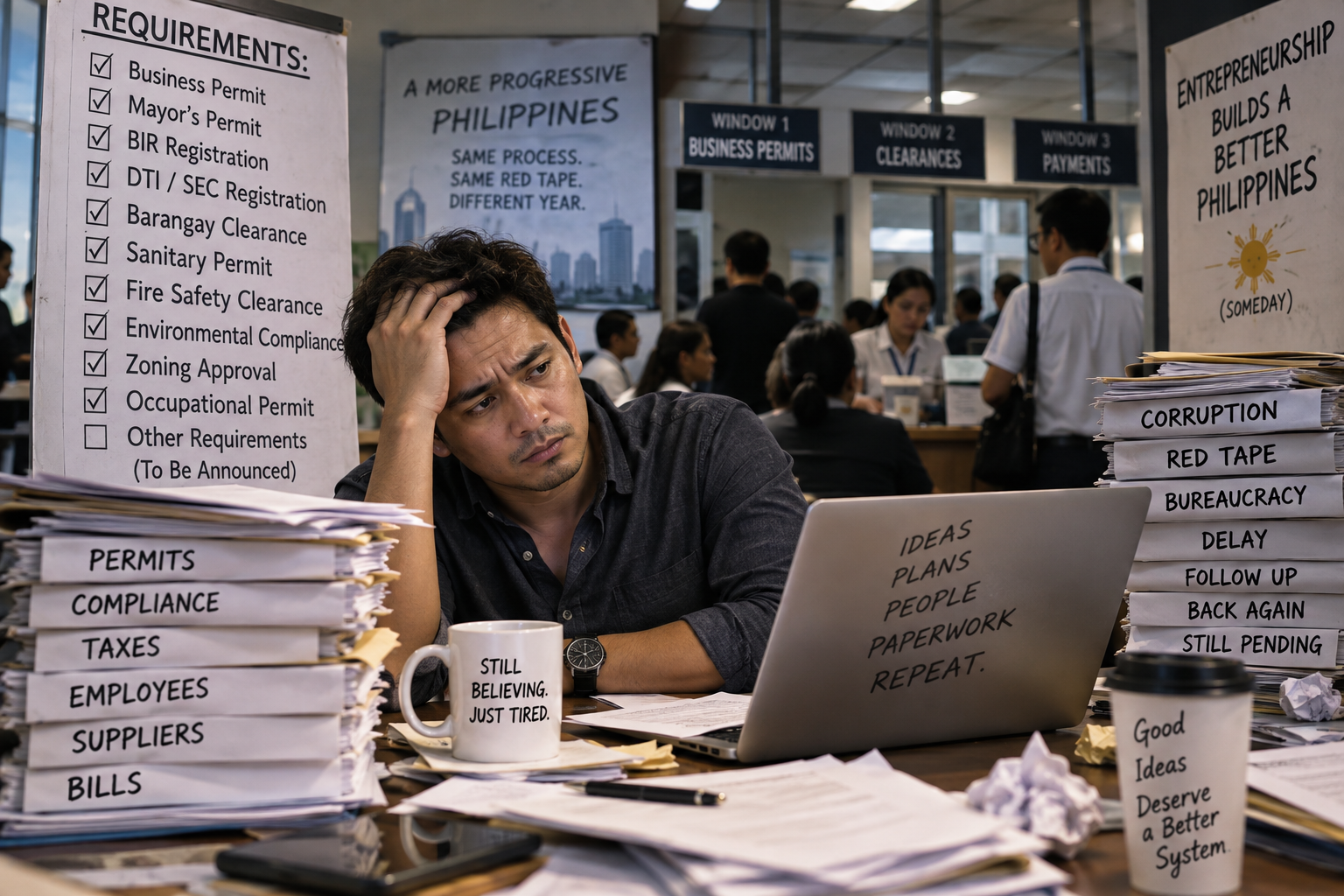
Part of what I do is create, build, maintain and manage different businesses. Some grow, some change direction, and sometimes, for perfectly valid business reasons, some have to be closed. If starting and running a business in the Philippines is difficult, closing one can be an even bigger nightmare.
I should probably clarify something before anyone reads the title of this article and starts sending me messages asking if my business has closed. No, this article is not an announcement that I have closed my current business.
Over the years, part of my work has been creating, developing and maintaining different businesses and business entities. That means I have experienced different stages of the business life cycle. I have started businesses, managed them, watched some grow, and changed direction when circumstances required it. And yes, there have also been businesses and entities that I eventually had to close.
That is simply part of being in business. Not every company is supposed to exist forever. Sometimes a project has served its purpose. Sometimes the market changes. Sometimes maintaining a particular entity no longer makes financial sense. Sometimes businesses are consolidated or strategies change. And sometimes, despite everyone's best efforts, a business simply doesn't work.
Whatever the reason, there eventually comes a point when you say, “Okay, this one has reached the end of its road. Let's close it properly.” That sounds simple, but it isn't. If there is something my years of dealing with different businesses in the Philippines have taught me, it is this: starting a business requires patience, running one requires endurance, and closing one may require divine intervention.
I'm joking. Mostly.
It Starts With a Dream—and a Lot of Paperwork
Whenever I create a new business, there is always some excitement involved. Every business begins with an idea. You see an opportunity. You imagine what it could become. You think about the people it could employ, the customers it could serve and the value it could create.
Then reality begins.
Depending on the type and structure of the business, there may be registrations involving the DTI or SEC. There are barangay and local government requirements. There is the BIR. Once you employ people, there are obligations involving SSS, PhilHealth and Pag-IBIG. There are registrations, permits, forms, deadlines, books, reports, contributions, taxes and renewals.
Every agency has a purpose, and I understand that. Businesses need regulation, taxes have to be collected, workers need protection and companies need accountability. But when you are the person actually creating and maintaining businesses, you begin to understand how much time and energy compliance consumes.
After completing everything required to establish the company, you still haven't made a single peso. You have simply received permission to try. Now comes the real challenge: you need customers.
Government Compliance Doesn't Care Whether You Had a Good Month
Your customers can disappear, your sales can fall, a major account can leave, and the economy can slow down. Rent can increase, electricity can increase, suppliers can raise their prices and salaries can go up. New regulations can also create additional costs. The obligations of the business, however, continue.
You still have payroll, rent, taxes, filings, government contributions and compliance requirements. You also have employees who need to support their families, and rightly so. The entrepreneur stands in the middle trying to make all the numbers work.
This is something employees understandably don't always see. A business can generate impressive revenue and still leave very little for the owner. Money enters the bank account and immediately gets attacked by payroll, taxes, rent, utilities, suppliers, benefits, software, equipment, loans, accountants and expenses you didn't even know existed when you started.
Whatever survives is called profit. Some months, there are no survivors. Then you wake up and do it again.
Then There Are the People Problems
Running businesses also means managing people, and that brings an entirely different set of challenges. I have been fortunate to work with excellent Filipino employees. Some are hardworking, loyal, intelligent, creative and deeply committed to their responsibilities. These are the people who remind you why building a company can be worthwhile, and when you find people like that, you value them.
But anyone who has managed businesses for a significant amount of time also knows the other reality. There are attendance problems, unexplained absences, employees who disappear without proper notice, and people who need repeated reminders about their responsibilities. There are conflicts, misunderstandings, complaints and situations where responsibility seems to become something everyone wants to pass to somebody else.
Of course, employers have responsibilities too. There are bad employers in the Philippines. There are companies that underpay workers, ignore labor standards and treat employees poorly. Workers need legal protection from those businesses. But the relationship works both ways.
A small business can be seriously damaged by just one or two bad hires. A multinational corporation can absorb those mistakes. A company with six employees cannot. Meanwhile, the entrepreneur still has to comply with labor regulations, mandatory contributions, wage adjustments and all the other responsibilities that come with employing people.
Nobody guarantees additional customers because your costs increased. You simply have to find a way.
Sometimes Closing a Business Is the Correct Business Decision
I also want to correct another misconception. Closing a business does not always mean the entrepreneur failed. This is important because people often hear that a company closed and immediately assume something went terribly wrong.
Sometimes it did. But sometimes closing is simply good business.
Markets change. Technologies change. Strategies change. Partnerships change. A company may no longer fit the direction of a larger organization. Maintaining an entity may cost more than the value it produces. A project may simply have completed its purpose. A responsible businessperson should be willing to look at the numbers and say, “This no longer makes sense.”
There is no wisdom in keeping a business alive simply because your ego doesn't want to close it. I have had to make those decisions myself. Some were easy and others were painful, but once the decision is made, you would think the next step would be straightforward: stop operating, settle your obligations, notify the government and close the company.
Unfortunately, that's where another adventure begins.
Your Business Has Stopped. Your Government Records Haven't.
Physically stopping operations does not necessarily mean the business has ceased to exist in the eyes of government. You cannot simply lock the door, put up a “CLOSED” sign and assume everything ends there.
A business has to be formally closed. Depending on its structure and circumstances, that can mean dealing again with several of the same institutions involved when you started: local government, the BIR, DTI or SEC as applicable, and agencies connected to employees and operations.
There is an almost beautiful symmetry to it. When you start a business, you go from agency to agency proving that the company exists. When you close it, you may find yourself dealing with agencies again to prove that it doesn't. Apparently, disappearing quietly is not an available business strategy.
The Hardest Closures Are the Ones That Already Cost You Everything
Not every business I have had to close was a failed business. But I have seen enough of entrepreneurship to understand how painful closure becomes when a company genuinely has failed.
Imagine an entrepreneur who has already exhausted his savings trying to save a struggling company. He may have borrowed money, continued paying employees, paid rent and suppliers, tried another marketing campaign, and repeatedly convinced himself that next month would finally be better. Eventually, however, there is nothing left.
The business closes, but the entrepreneur may already have lost his investment, accumulated loans and spent money that was originally intended for his family. Now he needs to formally close everything, and there may still be documents, clearances, filings, professional fees, outstanding obligations and penalties for missed requirements.
This is the point where I sometimes wonder whether our system understands the human being behind the registration number.
Rules matter. Compliance matters. Taxes matter. But circumstances should matter too. There is a difference between someone deliberately avoiding legitimate obligations and a small entrepreneur who has lost everything and is genuinely trying to close properly. I believe there should be room in our system for common sense and perhaps even a little mercy.
Give Entrepreneurs a Graceful Exit
We talk constantly about encouraging entrepreneurship. We tell people to start businesses, create jobs, innovate, take risks and become their own bosses. That all sounds wonderful.
But if we genuinely want Filipinos to take entrepreneurial risks, then we also have to accept that some businesses will eventually close. That is normal. Businesses are born and businesses die. Some become enormous companies, some remain small family businesses, some last generations, and others last only a few years. Some simply serve their purpose and disappear.
The government should make that entire life cycle easier to navigate. It should be easier to start, compliance should be understandable, and government systems should communicate with one another. It should also be reasonable to operate and, when the time comes, humane to close.
One coordinated process would already make an enormous difference. Tell the entrepreneur clearly what remains unpaid and which documents are missing. Settle legitimate obligations, protect employees and collect whatever is legally due. Then close the business and let everyone move forward.
Business Has Taught Me When to Hold On—and When to Let Go
One of the greatest lessons entrepreneurship has taught me is that persistence and wisdom are not always the same thing. We love stories about people who refused to quit, and there is tremendous value in perseverance. But sometimes the brave decision is to continue, and sometimes the brave decision is to stop.
Faith has helped me understand this better. I believe we should work hard for the things God has placed in our hearts. I believe we should persevere through difficulty. I believe we should pray, trust and keep moving when the road becomes hard. But I also don't believe every closed door needs to be kicked open.
Sometimes God closes a chapter because its purpose has been completed. Sometimes He removes something because we have been holding onto it longer than we should. And sometimes we simply made a bad business decision. God can teach us through that too.
Faith doesn't mean pretending every decision we make will succeed. Faith means believing that even when something ends, God can still use what we learned from it.
A Closed Business Is Not Always a Failed Dream
After years of creating and managing businesses, I have learned not to become too emotionally attached to a company simply because I created it. Businesses are vehicles. They allow us to create value, provide jobs, solve problems and hopefully earn money, but they are not our identity.
A company can close without your life closing with it. A project can fail without you becoming a failure. A business can end without the dream behind it disappearing.
Sometimes the lessons from one company become the foundation of another. Sometimes the people you met through one venture become partners in the next. Sometimes losing money teaches you something making money never could. And sometimes God allows one door to close because you would never have noticed the other door while you were still desperately trying to keep the first one open.
I Will Continue Building
After everything I've written here, perhaps the strangest part is that I still want to create businesses. Maybe there really is something wrong with entrepreneurs. We complain about the stress, taxes, paperwork, employees, government requirements and sleepless nights, and then somebody says, “I have a business idea,” and suddenly we're interested again.
Underneath all the frustration, I still believe in building. I believe businesses can improve lives. I believe entrepreneurs can create opportunities. I believe Filipino companies can compete with the world. And I believe our country will become stronger when good people are encouraged, rather than discouraged, to create businesses.
That is precisely why I write articles like this. It is not because I have stopped believing in entrepreneurship. It is because I believe we can make entrepreneurship better.
Starting a business in the Philippines is hard. Running one is harder. And from my own experience managing different businesses over the years, I can tell you that closing one can be a nightmare.
But I have also learned that businesses come and go. Money comes and goes. Success comes and goes. What remains are the lessons, the people we helped along the way, the wisdom we gained and the person we became through the experience.
So when a business has reached the end of its purpose, close it. Settle what needs to be settled, learn what needs to be learned, thank God for whatever the journey gave you, and then move forward.
Sometimes closing a business isn't the end of the entrepreneur. Sometimes it simply creates room for whatever God wants you to build next.
— Angelo R. Villamejor
The Rise of the Tycoon