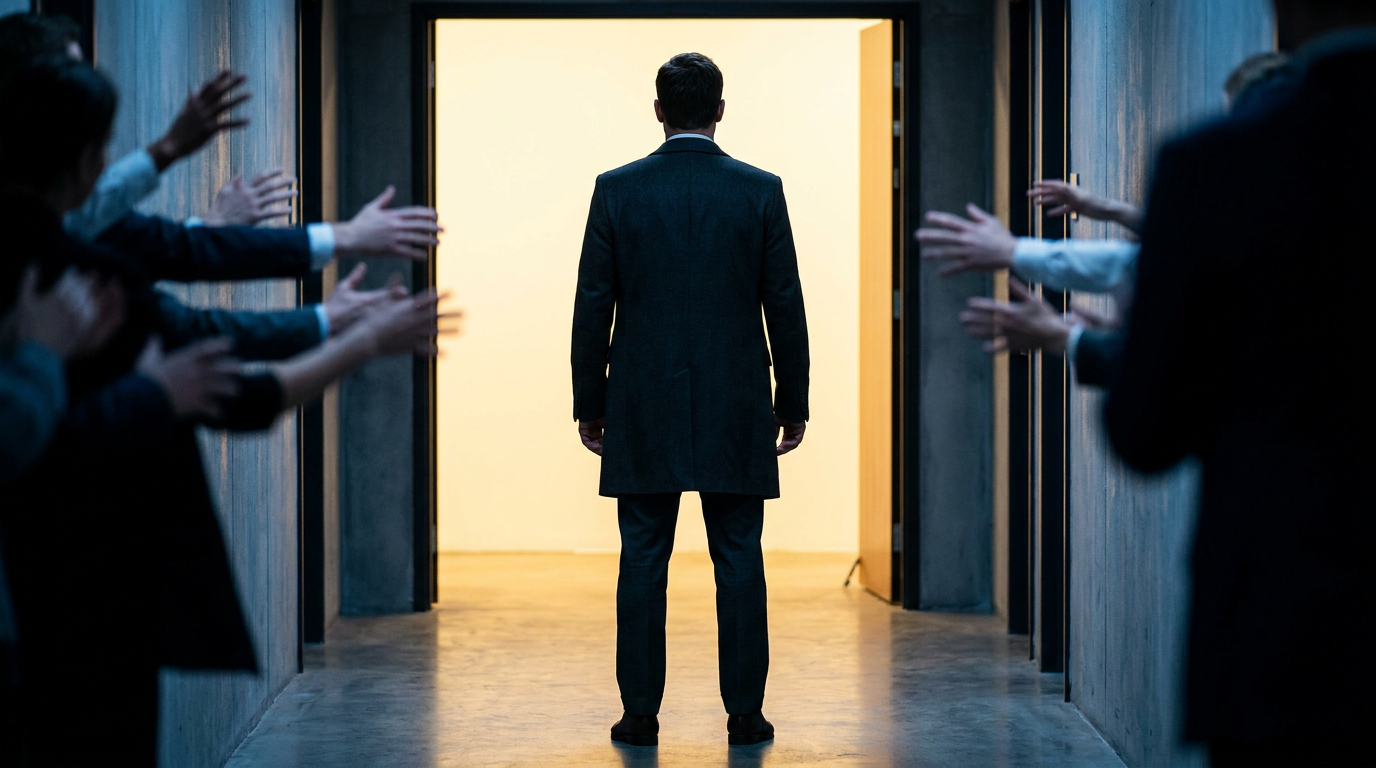
There is a story in Scripture that I have read more times than I can count, and yet somehow it keeps finding me exactly when I need it most — not in a church pew, not in a Bible study group, but in the quiet hours after midnight when I am staring at a spreadsheet and wondering if the company will make it through the month.
The story is about manna.
The Israelites had just been freed from Egypt — an entire nation, hundreds of thousands of people — and they found themselves in one of the most unforgiving stretches of land on earth. No fields. No harvests. No grocery stores on the corner. Just sand and sky and the terrifying silence of a desert that had no intention of feeding them. Their survival seemed not just difficult but genuinely impossible. And yet, every morning without fail, when they stepped outside their tents, the ground was covered in something they had never seen before. A fine, flaky substance that tasted like honey wafers. They called it manna — a word that, in its most honest translation, means simply, "What is this?"
What I find most remarkable about this story is not that God fed them. The miracle of provision, as astonishing as it is, is almost secondary to the instruction that came with it. God told them, through Moses, that they were to gather only enough for that day. Just one day's worth. No more, no less. And if anyone — driven by fear, by the reasonable and deeply human instinct to prepare for tomorrow — gathered extra and tried to store it overnight, the excess would spoil by morning. It would be full of worms. Unusable. Wasted.
For forty years this continued. Every single morning for four decades, the ground was covered with provision. And every single morning, the people had to make a choice: trust that it would be there again tomorrow, or try to control tomorrow by hoarding today.
God, in His wisdom, did not give them a year's supply at the start of the journey. He could have. He could have filled every tent with enough manna to last the entire forty years in the wilderness, and then some. Instead, He chose to show up every morning. He chose the daily rhythm not because He lacked the ability to provide in bulk, but because He was teaching them something far more valuable than how to fill their stomachs. He was teaching their hearts how to trust.
I have been thinking about this story a lot lately, and I want to be honest with you about why.
I run a small company. Most days, I love it deeply. OneNetworx has multiple business lines — insurance, sales outsourcing, marketing, travel, virtual office spaces — and we operate with a lean team of less than twenty people who work harder than most people I know. We carry the weight of loans, payroll, utility bills, and the ongoing cost of simply keeping the lights on. There are seasons when business flows easily, when the phones ring and the collections come in and the numbers make sense. And then there are the other seasons.
In those other seasons — the slow months, the quarters when cash flow tightens and collections fall short and you find yourself moving money around like pieces on a board just to cover the basics — I have noticed something uncomfortable about myself. My peace is not anchored in God. It is anchored in my bank balance.
When the buffer is healthy, I sleep well. When the reserve fund is where I want it to be, I feel a quiet, steady confidence that everything is going to be alright. My leadership is calmer. My decisions are clearer. My mood, if I am completely honest, is noticeably better. But the moment cash flow tightens — the moment I look at the numbers and see something that does not reassure me — everything shifts. The anxiety creeps in like fog. Sleep becomes restless. I find myself refreshing financial reports at hours when I should be resting, running mental calculations that almost never lead anywhere useful, and carrying a low-grade fear that shadows every decision I make.
And here is what I realized, sitting with this one quiet morning when I had no one to answer to but God: I had fallen into the exact same trap as the Israelites. Not because I was saving money — that is not the sin, and I will come back to that. But because somewhere along the way, my trust had quietly migrated. It had moved from the God who provides to the evidence of His past provision. I was trusting the stored manna. I had forgotten the One who sends it every morning.
Building a business in the Philippines as a small owner is not for the faint of heart. I want to say that plainly, because I think we sometimes dress up entrepreneurship in language that makes it sound more glamorous than it actually is in the day-to-day. The reality is that there are months when you are juggling priorities that cannot all be satisfied at once. There are partners who delay payments, clients who take longer than expected to decide, employees who depend on you for their families' meals — and all of it rests, in some final analysis, on your ability to keep the engine running.
I have lived the full cycle of that reality. I have experienced the months when everything flows and you feel almost invincible, and I have experienced the months when you wonder if you made a terrible mistake ever believing this thing could work. In the lean seasons, I have noticed how my leadership changes. I become more cautious, sometimes more guarded, occasionally more short-tempered than I should be. I push my team harder from a place of anxiety rather than inspiration. I make decisions not from vision but from fear. And the most painful part of that pattern is that it is not because God has left. It is because I stopped looking up in the morning.
I stopped gathering my daily manna.
What if the lean months are not a punishment? What if they are not a sign of failure, or a signal that something fundamental has gone wrong? What if they are, in fact, the same test the Israelites faced in the desert — God asking His people, again, "Do you trust Me for tomorrow, or only for what you can secure for yourself today?"
The manna was never the miracle. The daily faithfulness of a God who showed up every single morning for forty years — that is the miracle. Forty years. Not one morning missed. Not one day when the Israelites woke up and found the ground bare. Every morning, without exception, the provision was there. The miracle was not the food. The miracle was the relationship. It was the invitation to dependency, to the daily act of walking out of your tent with open hands and saying, I need You today. I cannot make it without You today.

No spreadsheet I have ever built carries that kind of track record. No savings account holds that kind of assurance. And yet I have spent years of my entrepreneurial life building precisely those things — buffers and reserves and contingency funds — and then slowly, without meaning to, placing my deepest confidence in them rather than in the One who filled them.
Let me be clear about something important. Saving is not faithlessness. Having a buffer fund is not a lack of trust in God. Wise stewardship is, in fact, one of the most biblical things a business owner can do. God gave us minds for planning and hands for working, and there is no virtue in recklessness disguised as faith. The Israelites were allowed to gather enough for the day. The instruction was not "gather nothing" — it was "gather what you need, and trust Me with the rest."
The problem was never the saving. The problem was where my peace was located. The problem was that when the buffer shrank, my faith shrank with it — as though the size of my reserve somehow determined the size of my God.
I am writing this as honestly as I know how because I suspect I am not alone in this. If you are a business owner, if you carry payroll, if you have ever lain awake at night running numbers in your head that would not bring you comfort no matter how many times you ran them — I think you know exactly what I am describing. The anxiety is not just about money. It is about identity. It is about the terrifying vulnerability of having built something that you love, something that employs real people with real families, and knowing that it depends in some measure on forces you cannot entirely control.
And into that specific, particular, deeply personal kind of fear, the manna story speaks with remarkable precision. God was not teaching the Israelites to be passive. He was not telling them to sit in their tents and wait. He was asking them to get up every morning, go out, and gather — to do the work of the day — while simultaneously releasing their grip on tomorrow. The gathering was their part. The provision was His.
That is the balance I am still learning. Do the work. Plan wisely. Steward well. Build the company with everything you have. And then, when the day is done and the numbers are what they are and tomorrow is still out of your hands — rest. Not because everything is perfect, but because the God who fed a nation in a desert for forty years has not forgotten your name, your business, or your family.
He has never missed a morning yet.
If you are reading this today and you are in a lean season — if the collections are slower than you hoped, if the clients are quieter than usual, if you are staring at a set of numbers that do not seem to add up the way you need them to — I want to say this to you as gently and as directly as I can: your business is not outside God's awareness. He sees the shortfall. He knows the names of your employees. He knows exactly how much you need, and when you need it, and where it is going to come from.
I do not say that to minimize the difficulty. I say it because I believe it, even in the moments when believing it costs something. Faith that only functions in abundance is not really faith — it is just contentment. The kind of trust that matters, the kind that actually changes how you lead and how you live, is the kind that says on the hard mornings: I am going to go out and gather what is here today, and trust that tomorrow is already being prepared.
Have your savings. Build your reserves. Plan for the next quarter and the next year and the next decade. Be a good steward of every peso God puts in your hands. But let your peace be anchored not in the balance, but in the One who fills it. There is a richness no amount of money can replicate — the deep, unshakeable assurance that you are not building alone, that provision will come, and that the same God who covered the ground with manna every morning for forty years has already thought about your tomorrow.
He will be there when you open the tent.
Lord, teach me to gather enough for today, and to trust You completely with tomorrow. Amen.