I used to believe that the Philippines did not need democracy to prosper. What we needed, I told myself, was discipline. Strong leadership, order, a firm hand. Democracy looked noisy, slow and messy.
I no longer believe that. Democracy has a bad side, yes. But it has a good side, and right now that good side may be the only tool we have left: it lets us speak.
The numbers we are living with
You don't need an economist to tell you something is wrong. Check your grocery receipt, your fare, your electric bill. But the numbers say the same thing:
- Inflation hit 7.2% in September 2026, up from 6.1% in August. That is a three-and-a-half-year high and well above the central bank's 2–4% target. Core inflation, which strips out volatile food and fuel, rose to 4.7%, a sign that price pressure is spreading.
- The peso closed at a record-low ₱63.361 to the dollar on October 20, which makes imported fuel, food and raw materials even more expensive.
- The Bangko Sentral raised its rate by 50 basis points to 5.50% on October 22, its fourth straight hike this year. It now expects inflation to average 6% in 2027.
- Growth has stalled. GDP grew just 2.3% in the second quarter, a post-pandemic low. The IMF projects 3.4% for 2026, which would be the fifth-slowest in Southeast Asia, behind Vietnam, Malaysia, Indonesia and Singapore.
- More Filipinos will be out of work. The IMF now sees unemployment climbing to 5.4% this year, up from its earlier 4.7% estimate.
Part of the blame goes to the Middle East war and the energy shock. But the IMF and our own economic reporting also point to something closer to home: the lingering damage of the flood control mess, which delayed public infrastructure spending and shook investor confidence. The IMF's own warning is that recovery depends on "restoring public investment while strengthening governance." Strengthening governance. That is a polite way of saying: stop the corruption.
"Resilience" is not an economic policy
A new study by Organic Intelligence, Pinoy, Kaya Pa Ba?, reported by Rappler, should make every one of us stop and think. Nearly half (48%) of urban Filipinos surveyed rejected the romanticized idea of "Filipino resilience." Among 18–24-year-olds, it was 64%.
Look at what sits behind that:
- 44% don't have enough savings to survive three months without work.
- 45% say inflation has drained them to the point of losing their drive to get ahead.
- 46% took out a loan in the past one to two months, and 42% borrowed for basics like food and transport.
- Outstanding consumer loans hit ₱2.84 trillion in August, up 17% in a year, and bad consumer debt is rising.
As researcher Jason Ligot put it: "We are not rejecting resilience per se. What we are rejecting is the necessity of it... why is the onus always on me?"
That question is the heart of this article. We have been praised for enduring. We have been told "Bagyo ka lang, Pinoy kami." But a people forced to be resilient every single year, because those who hold power keep failing them, is not being celebrated. It is being used.
(A fair note: the study surveyed 800 urban Filipinos online in May 2026, so it doesn't capture every voice, especially in rural areas. But it matches what many of us feel.)
I have seen this before
I was 11 years old during the time of the late President Ferdinand Marcos Sr. I was a child, but I remember the mood at home and in the streets. People distrusted the government. Corruption was talked about everywhere. Prices kept climbing. The economy was failing ordinary families. Historians record that the economy collapsed in the mid-1980s, with runaway inflation and deep recession, and that the country was left with a mountain of debt.
Today, under the son of that same family name, many of us feel that same weight again.
Bakit hindi pa rin tayo natuto?
About those votes
Before the 2022 election, I remember many millennials confidently backing Marcos Jr. and mocking Leni Robredo as "lugaw." So let me check the facts, because we should be honest with each other:
- Millennials were the biggest voting bloc. Comelec data showed millennials (ages 26–41) and Gen Z (18–25) together made up over 56% of registered voters in 2022.
- Support was high across the board. In Pulse Asia's February 2022 survey, Marcos Jr. was the choice of about 63% of those aged 25–34 and 63% of those aged 35–44. Among 18–24-year-olds it was 71%. Even among older Filipinos, it was around 50–55%.
So the honest answer: millennials were not the only reason, and they weren't even his strongest age group (Gen Z was). But as the largest bloc, with roughly six in ten of them leaning his way in the polls, they were a major part of the story. Rappler also documented how massive online propaganda and disinformation networks had worked for years to polish the Marcos image and downplay Martial Law abuses, which had a strong effect on a generation that never lived through it.
I don't write this to shame anyone. I write it because the mistake is not "belonging" to one generation. It is a mistake we all share, and one we can all fix. Many of those who voted for him then are the same ones now struggling to pay for rice, rent and electricity. If your own experience has changed your mind, that is not weakness. That is wisdom.
Why democracy, and why now
The voice of the Filipino people installed this government. That same voice has the right, and I believe the duty, to hold it accountable.
Democracy gives us the tools:
- The ballot. Remember who voted for what, and why, in the next election, and tell others.
- The right to speak and assemble peacefully. Protests, petitions, forums, and open letters are not "negativity." They are citizenship.
- The law. Demand investigations, audits and prosecution through Congress, the courts, the Ombudsman and the Commission on Audit. Public officials who stole from flood control and other funds must face the law, whoever they are.
- A free press and an informed public. Check before you share. The same tools that were used to mislead us can also be used to inform us.
We must do all of this peacefully and within the law. The goal is not chaos. The goal is accountability.
And we cannot afford to wait another month or another year. Every month of delay is another month of 7% inflation, another month of borrowing for food, another month of billions lost to corruption that should have built roads, schools, and flood defenses.
So, should our voice be the same as 1986?
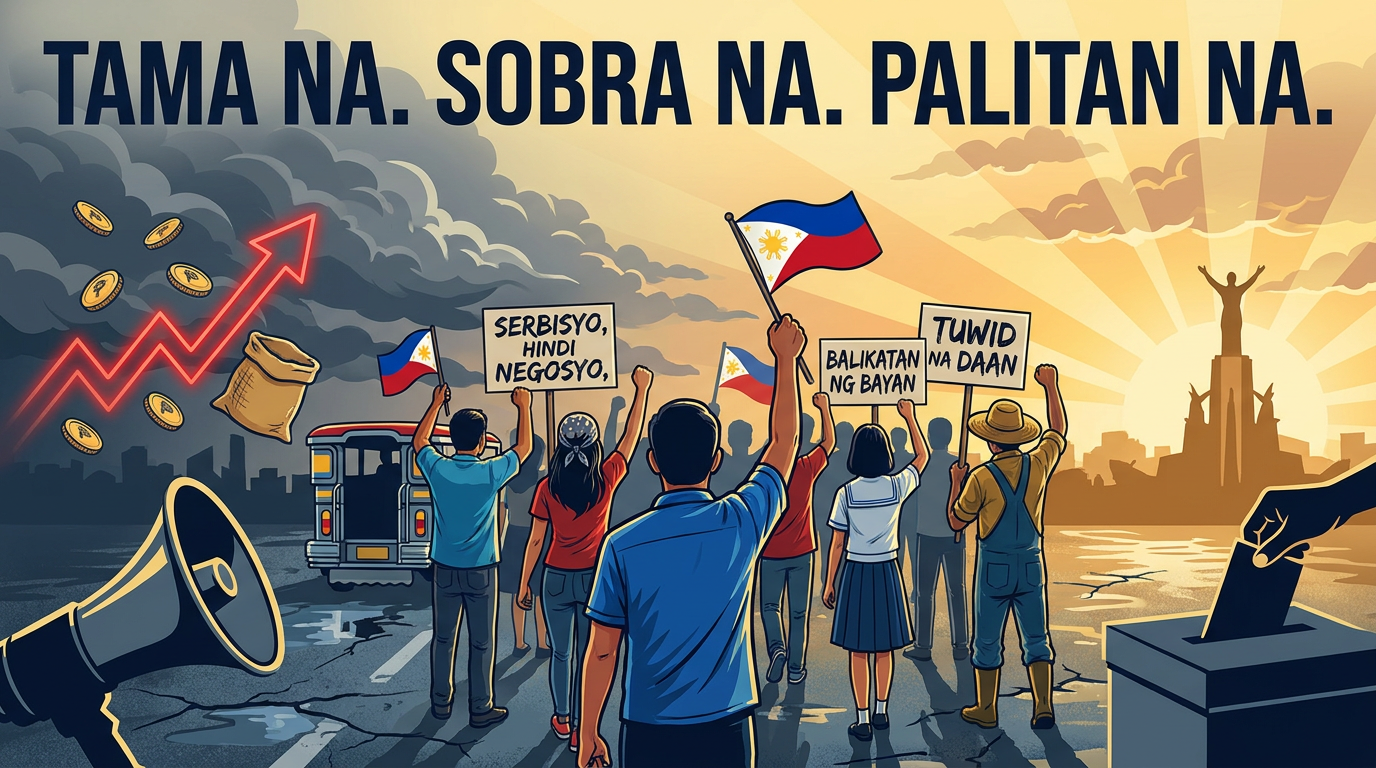
Tama na. Sobra na. Palitan na.
In 1986, those words were not about hatred. They were about a people who had reached their limit and refused to stay silent. I believe the spirit of those words belongs to us again, not as a slogan to repeat, but as a promise to act:
- Tama na to corruption that eats up our taxes.
- Sobra na to a government that asks us to be "resilient" while it fails us.
- Palitan na every unworthy official, through the vote, through the law, through the loud and peaceful voice of the people.
I once thought we needed discipline instead of democracy. I now understand that discipline and democracy are not enemies. The most disciplined thing a people can do is to stay awake, stay informed, and stay united in demanding better from those they put in power.
Our voice put them there. Our voice can hold them to account. Let's use it. Now.
Sources
- Rappler, "The urban Filipino is tired, cash-strapped, and sick of the 'resilience' excuse," Oct. 23, 2026 (Organic Intelligence Pinoy, Kaya Pa Ba? study; BSP consumer loan data)
- Rappler, "Bangko Sentral raises interest rates to 5.50% as inflation, peso woes mount," Oct. 22, 2026
- BusinessWorld, "Philippines to see sluggish growth, rise in unemployment this year, says IMF," Oct. 13, 2026
- Rappler, "Marcos Jr. is top pick of Generation Z, says Pulse Asia survey," Mar. 14, 2022
- GMA News and Inquirer, Comelec data on voter age groups, 2022 elections