Investigation / Public Money / Accountability

Millions for Flood Control. A School Underwater. What Happened in San Simon?

In San Simon, Pampanga, millions of pesos have been allocated to flood-control infrastructure over the years. Yet communities continue to suffer severe flooding. The story of one flooded school raises a question every Filipino taxpayer deserves to ask: What did we actually get for our money?

Angelo R. Villamejor Sep 13, 2026
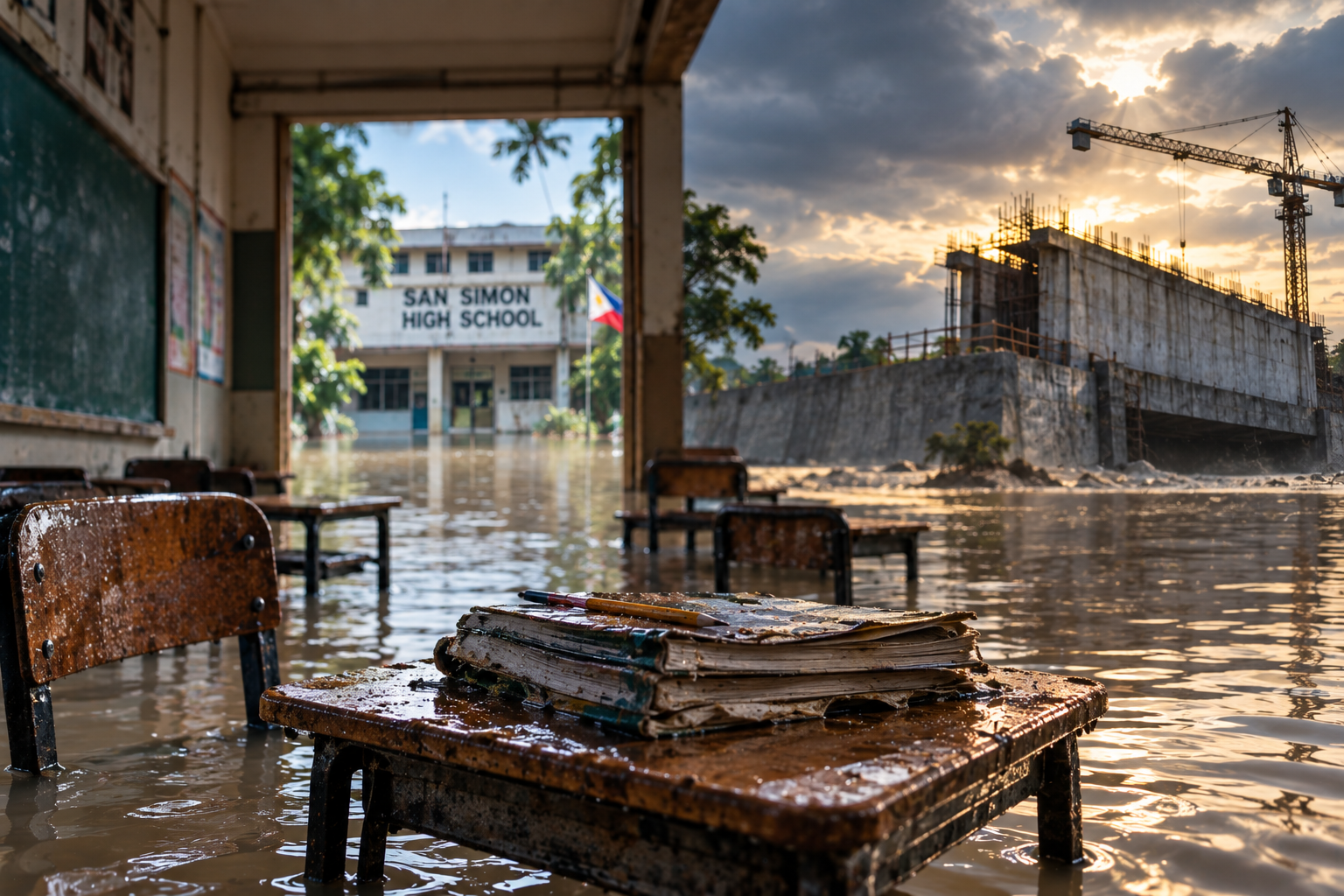
Editorial illustration of a flooded classroom at San Simon High School, with student desks in murky floodwater and an unfinished concrete flood-control structure looming beyond the courtyard. Illustration — not a photograph of the actual event.
Editorial illustration — not a photograph of the actual event.

There is something particularly painful about seeing a school underwater.

A flooded highway means traffic.

A flooded business means lost income.

A flooded home means a family suddenly wondering what can still be saved.

But a flooded school?

That is the future being interrupted.

At San Simon High School in Pampanga, video footage shared on Facebook shows the impact of flooding on a place built for an entirely different purpose.

A school should be filled with voices.

Teachers explaining lessons. Students laughing in hallways. Chairs scraping against classroom floors. Pages turning.

Instead, there was water.

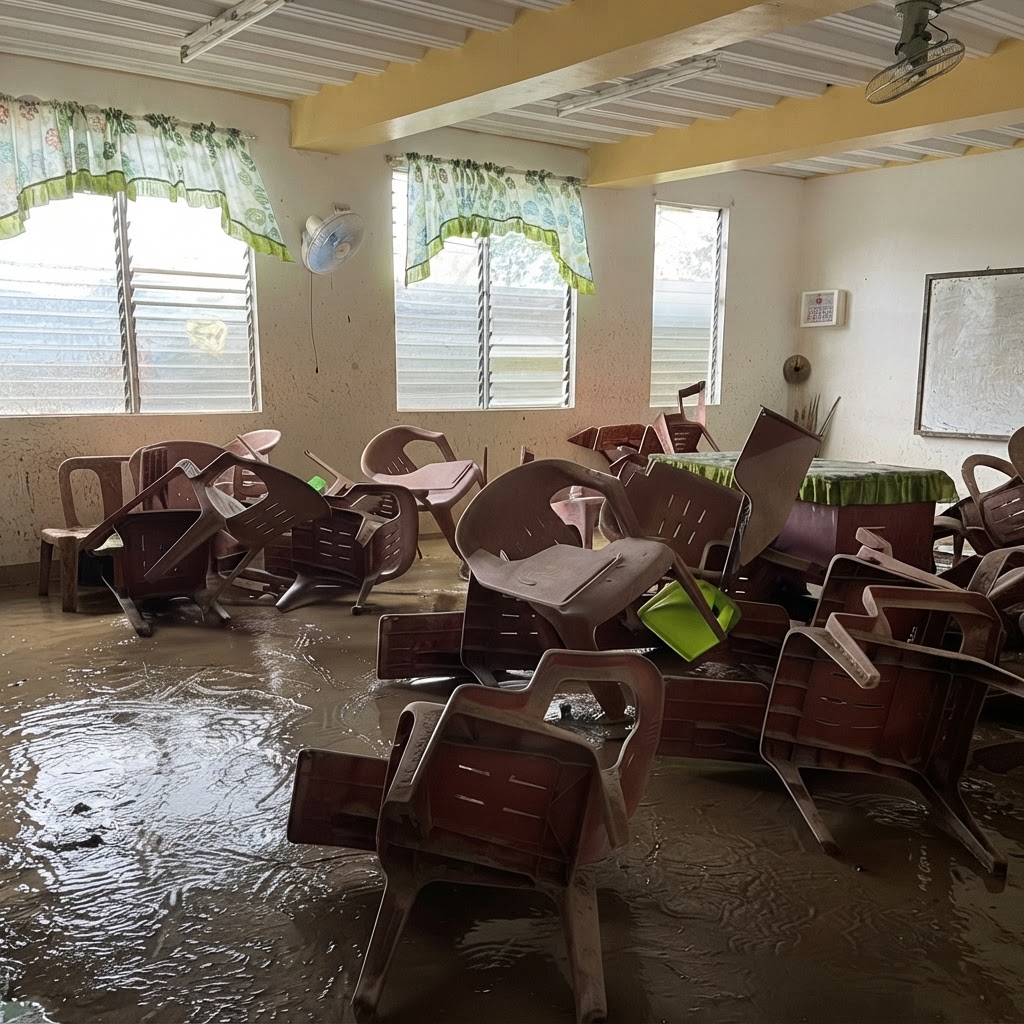
Flooding at San Simon High School — video still
Watch the original video on Facebook
Video: Flooding at San Simon High School, San Simon, Pampanga. Source: Facebook.

Look carefully at that video.

Then remember one thing:

Filipinos have been paying for flood control for years.

And San Simon has been receiving flood-control projects for years.

So perhaps it is time to ask a question that should make every taxpayer uncomfortable.

What happened?

Follow the Money to San Simon

This is not the first time San Simon has appeared in a story about flood-control infrastructure.

In 2017, a project called the Rehabilitation of Pampanga River Basin, Barangay San Nicolas, San Simon, Pampanga was undertaken by the Department of Public Works and Highways.

Government records identify D.L. Cervantes Construction Corporation and Ferdstar Builders as the joint-venture contractor.

DPWH records put the contract at approximately ₱144.3 million.

Then something happened that should have been difficult to forget.

The structure partially collapsed before the project was finished.

GMA Public Affairs' Reporter's Notebook investigated the project in 2018, reporting that the flood-control structure worth more than ₱140 million had collapsed following heavy rain even before its completion.

VERA Files subsequently documented the project details from its government-mandated project billboard.

This happened in San Simon.

Not somewhere else.

Not in another province.

San Simon.

And yet that was not the end of flood-control spending in the municipality.

Then Came More Projects

Government procurement documents for 2025 show at least three major flood-management projects specifically identified in San Simon.

One involved rehabilitation of the eroded Pampanga River bank in Barangay San Jose, with an approved budget for the contract of:

₱120,625,000.

Two more involved slope-protection structures along the Pampanga River in Barangay San Miguel.

Phase I:

₱144,750,000.

Phase II:

₱144,750,000.

Taken together, those three approved contract budgets amount to approximately:

₱410.125 MILLION

And those are only three projects from one procurement package.

This does not prove that the money was stolen.

It does not prove those projects caused or failed to prevent the flooding at San Simon High School.

And it would be irresponsible to claim otherwise without evidence.

But it establishes something important:

large amounts of public money have continued to be allocated for flood-management infrastructure in San Simon.

That makes the next fact difficult to ignore.

₱132 Million in Flood-Control Infrastructure Was Reported Damaged

In 2025, after severe weather hit Pampanga, the provincial government assessed damage to infrastructure around the province.

Among the damage reported:

₱132 million in partially damaged flood-control infrastructure in San Simon.

Read that again.

₱132 million.

Not for building something new.

That was the reported value associated with flood-control infrastructure that had already been partially damaged.

And then came 2026.

The water returned.

San Simon Went Under Again

Heavy monsoon rains once again brought severe flooding to Pampanga in August and September 2026.

San Simon became one of the most visible examples.

Flooding around the San Simon section of the North Luzon Expressway contributed to extraordinary traffic congestion.

Classes in San Simon were suspended as communities continued dealing with flooding.

And at San Simon High School, the consequences reached the classroom.

The Facebook footage is not a government spreadsheet.

It is not an appropriations bill.

It is not a procurement document.

It is what government failure—whether caused by inadequate planning, failed infrastructure, extreme weather, corruption, or some combination of those factors—can look like to an ordinary citizen.

Water where children are supposed to learn.

But Was Corruption Responsible?

Here we must be careful.

Anger is not evidence.

The Philippines is currently confronting an enormous scandal involving alleged ghost, substandard and ineffective flood-control projects.

But that does not automatically mean corruption caused every flood in the country.

San Simon lies within the complicated Pampanga River basin.

During the 2026 flooding, DPWH Secretary Vince Dizon pointed to the enormous volume of water brought by the southwest monsoon and the difficulty of draining it through the system.

Pampanga Governor Lilia Pineda also described backflow problems affecting communities as downstream areas remained full.

Other reporting indicated that breached dikes along the Pampanga River contributed to the flooding.

So the truth is more complicated than a slogan.

But complexity should not become an excuse for avoiding accountability.

Because the relevant question is not simply:

"Did corruption cause this particular flood?"

The larger question is:

After years of flood-control spending, documented infrastructure failures and repeated flooding, has government delivered the protection Filipinos paid for?

That question deserves an answer.

And Now Government Says San Simon Needs More

After the 2026 flooding, government officials announced additional interventions.

DPWH said detention basins would be constructed in San Simon as part of a longer-term solution.

Officials also discussed dredging waterways, closing vulnerable gaps and installing or strengthening barriers.

There is an almost painful irony here.

After years of projects...

after hundreds of millions of pesos...

after a flood-control structure collapsed before completion...

after ₱132 million in flood-control infrastructure was reported partially damaged...

after communities flooded again...

the answer is once again:

We need to build more.

Perhaps we do.

San Simon genuinely needs protection.

But Filipinos are entitled to ask something before another peso disappears into concrete:

What happened to what we already paid for?

This Is Bigger Than San Simon

The numbers become staggering when we leave Pampanga and look at the entire country.

In a 2025 Senate privilege speech, Senator Panfilo Lacson said more than ₱1.9 trillion had been appropriated for the DPWH flood-control management program from 2011 through 2025.

More than ₱1 trillion was appropriated in just the three years from 2023 through 2025.

Think about that number.

₱1,900,000,000,000.

Numbers that large become almost meaningless to ordinary people.

So forget the trillion for a moment.

Look at the classroom.

That is what public spending is supposed to protect.

Corruption Is Not Just About Money

When we hear that public money may have been stolen, we imagine envelopes.

Suitcases.

Bank accounts.

Kickbacks.

But corruption in infrastructure has another dimension.

Suppose money intended for protection disappears through a ghost project.

What was stolen?

Not merely money.

A flood wall that could have existed.

A stronger dike that could have existed.

A drainage system that could have worked better.

A classroom that might have been better protected.

We cannot say that any particular missing peso would have prevented the flooding at San Simon High School.

But we can say something much simpler:

Every peso stolen from infrastructure is a peso that cannot protect the public.

That is why the national flood-control corruption investigation matters.

The Palace said in August 2026 that investigations remain ongoing into projects suspected of being ghost, substandard or ineffective.

This is no longer merely an argument between politicians.

It is a question of whether public institutions can be trusted with public money.

Every peso stolen from infrastructure is a peso that cannot protect the public.

We Paid for This

There is another uncomfortable truth.

Politicians often speak of government money as though it belongs to government.

It doesn't.

It belongs to us.

Every employee who sees deductions on a payslip contributes.

Every entrepreneur who pays taxes contributes.

Every family paying VAT contributes.

Every Filipino buying goods and services participates in financing the state.

The billions appearing in government budgets did not magically appear in Congress.

They came from a country where many parents carefully budget grocery money.

Where employees count the days until payday.

Where small-business owners struggle with rent, electricity and salaries.

Where teachers sometimes spend their own money on classroom supplies.

And where taxpayers are repeatedly told that there is not enough money for everything.

If money is scarce, then wasting it is unforgivable.

Stealing it is worse.

Congress Must Be Watched

There is another reason ordinary Filipinos should care about the flood-control scandal.

The national budget passes through Congress.

Budget amendments themselves are not inherently corrupt or illegal. Legislators have constitutional responsibilities in appropriations, and legitimate amendments can fund badly needed infrastructure, classrooms, hospitals and other services.

But the flood-control investigation exposed serious allegations involving budget insertions and infrastructure spending.

Senate investigations have examined claims that some projects were manipulated through corrupt arrangements involving contractors, government personnel and political actors.

Some lawmakers accused during the wider investigation have denied wrongdoing.

That distinction matters.

Not every member of Congress is corrupt.

Not every budget insertion is corrupt.

Not every contractor is corrupt.

And not every flood-control project is fake.

But neither should Filipinos use those truths as excuses to stop asking questions.

The people who help decide how hundreds of billions of pesos are spent must face extraordinary scrutiny.

Because power over the budget is power over our money.

Democracy does not ask us to worship leaders. It asks us to watch them.

Your Vote Is Not a Love Letter

Perhaps Filipinos need to rethink what voting means.

A ballot is not a declaration of loyalty.

It is not repayment for assistance received.

It is not an endorsement of a surname.

It is not a reward for entertainment.

It is not a love letter to a politician.

It is a contract.

You are temporarily giving another human being enormous power.

Power to write laws.

Power to investigate.

Power to influence public spending.

Power that can affect whether your community receives a hospital, a classroom, a road—or flood protection.

So before giving anyone that power, ask questions.

What did this person do with power before?

Where did public money go?

What projects were funded?

Who received the contracts?

Were they completed?

Did they work?

When allegations appeared, did the official demand answers—or avoid them?

Democracy does not ask us to worship leaders.

It asks us to watch them.

A ballot is not a love letter. It is a contract.

Do Something Before You Forget

There is a familiar cycle in the Philippines.

Disaster.

Anger.

Investigation.

Hearings.

Headlines.

Memes.

Then another controversy arrives.

And slowly, we forget.

That may be the most dangerous part.

Because corruption does not require every citizen to approve of it.

Sometimes it only requires citizens to forget.

So don't merely share this article.

Do something.

Look up flood-control projects in your municipality.

Photograph government project billboards.

Write down contract numbers.

Search procurement records.

Ask your mayor.

Ask your governor.

Ask your district representative.

Ask DPWH.

Ask:

How much did this cost?

Who built it?

When was it completed?

Who inspected it?

Is it still standing?

And if something appears wrong, document it and bring it to legitimate authorities, journalists or watchdog organizations.

Citizens do not need to become engineers.

They need to become difficult to fool.

Remember San Simon High School

One day, the water will disappear.

Someone will clean the floors.

Someone will remove the mud.

Teachers will return.

Students will sit down again.

Lessons will resume.

And politicians will praise Filipino resilience.

But perhaps we should stop being satisfied with resilience.

Filipinos should not have to become experts at recovering from failures that good government was supposed to prevent or reduce.

Children should not have to become symbols of resilience because adults failed to build systems worthy of them.

So remember San Simon High School.

Not because we have proven that corruption flooded its classrooms.

We haven't.

Remember it because those classrooms force us to confront a larger question.

We have spent billions.

Nationwide, we have appropriated trillions.

We have built flood-control structures.

We have repaired them.

Some have failed.

We have built again.

And communities are still going underwater.

Before we spend the next billion, somebody needs to answer for the last one.

And before the next election, perhaps every Filipino should ask themselves one final question:

Who am I willing to trust with my money, my community and my children's future?

Do not answer that question with anger.

Do not answer it with loyalty.

Do not answer it because somebody told you whom to hate.

Before we spend the next billion, somebody needs to answer for the last one.

Find the records.

Follow the money.

Demand the truth.

Then decide for yourself.

Because the floodwater will eventually recede.

But our memory must not.

Sources & Documents

  • Department of Public Works and Highways (DPWH) — Project records: Rehabilitation of Pampanga River Basin, Barangay San Nicolas, San Simon, Pampanga (2017).
  • PhilGEPS — 2025 procurement documents for flood-management projects in San Simon, Pampanga (Barangay San Jose; Barangay San Miguel, Phases I–II).
  • Philippine Information Agency (PIA) — 2025 reports on storm damage to Pampanga infrastructure.
  • Philippine News Agency (PNA) — 2025 reports on partially damaged flood-control infrastructure in San Simon, Pampanga.
  • Senate of the Philippines — Sen. Panfilo Lacson's 2025 privilege speech on DPWH flood-control management appropriations, 2011–2025.
  • Presidential Communications Office (PCO) — August 2026 statement on ongoing investigations into suspected ghost, substandard and ineffective flood-control projects.
  • GMA News / GMA Public Affairs — Reporter's Notebook (2018): investigation of the collapsed flood-control structure in San Simon, Pampanga.
  • VERA Files — Documentation of the San Simon Pampanga River basin project billboard.
  • Facebook — Original public video post: flooding at San Simon High School, San Simon, Pampanga.Visit source
Share

OneNetworx Insights

Stay Connected with OneNetworx

Get selected insights on business, entrepreneurship, technology, leadership, opportunities and purposeful growth delivered in our weekly digest.

Weekly. Useful. Unsubscribe anytime.