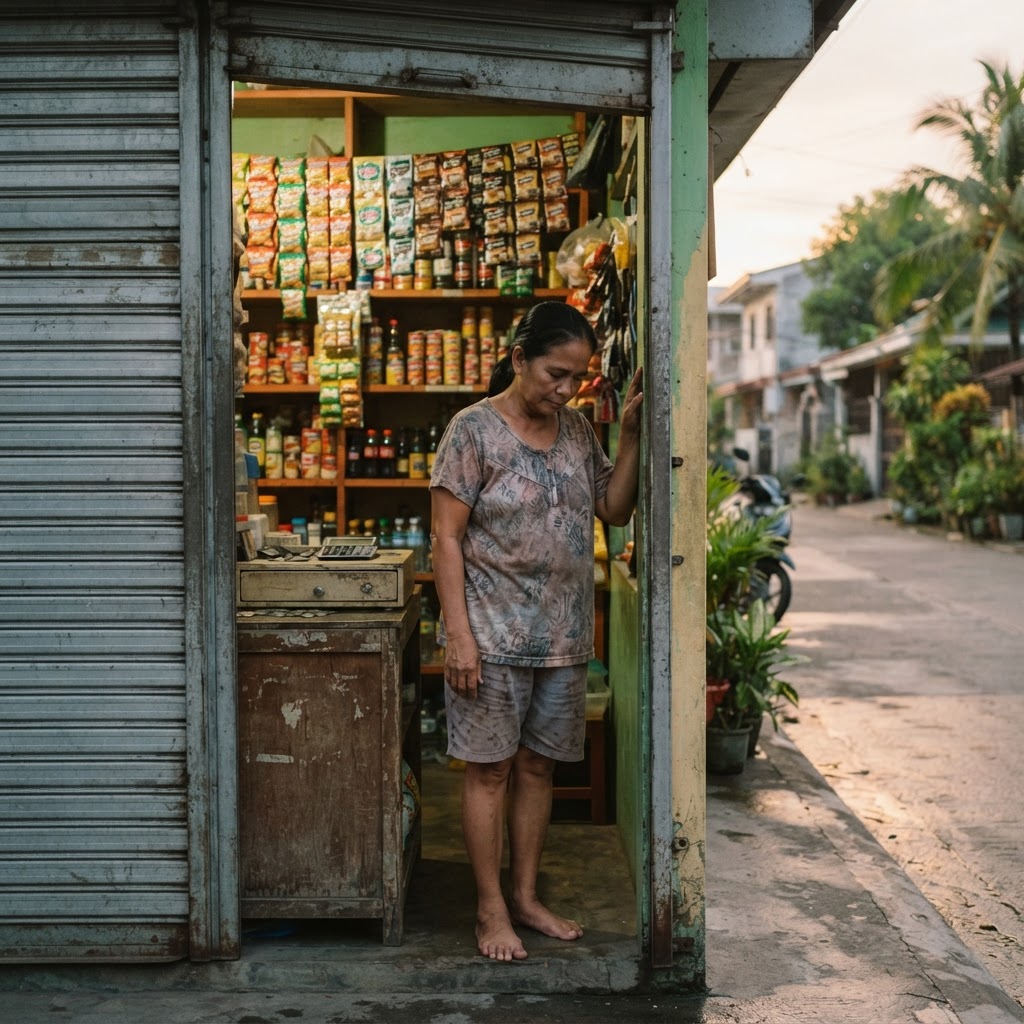
Walk into almost any small business in the Philippines — a sari-sari store, a home bakery, a logistics startup run out of a garage — and you will likely find some trace of faith nearby. A rosary looped around a motorcycle mirror. A framed prayer above the cash drawer. A Facebook caption after a good sales day: "Salamat, Lord, blessed po kami."
This is not a complaint about faith in business. Faith, for many owners, is the thing that gets them up before dawn to open the store, that steadies them through a bad month, that gives meaning to work that would otherwise just be exhausting. That is real, and it deserves respect.
But there is a quieter pattern worth naming: the way faith language sometimes gets used not to deepen ethical responsibility, but to avoid it. "Blessed" becomes a word that explains outcomes without examining the choices that produced them. And that gap — between the vocabulary of faith and the discipline of actually acting on it — is where a lot of business owners, without meaning to, let themselves off the hook.
The Comfort of the Vocabulary
Faith language is appealing in business partly because it is comforting and partly because it is unfalsifiable. If sales are good, it was a blessing. If sales are bad, it was a test, or not yet the right season, or something to surrender. Either way, the explanation sits above the level of decision-making. It never quite asks: did I price this fairly? Did I pay my supplier on time? Did I treat the rider who delivered this order with the respect his labor deserved?
This is not unique to any one culture, but it shows up in a distinctly Filipino register because faith is so woven into daily commercial life. Prayers before opening the store. Testimonies of answered prayer tied directly to business milestones. A genuine and admirable instinct to give credit upward rather than take it for oneself.
The risk is subtle. When every outcome is framed as providence, there is less room left to ask harder questions about process — about whether the outcome was actually earned the right way, or whether someone along the chain absorbed a cost that never got acknowledged.
Where the Gap Actually Opens
The gap rarely shows up as outright hypocrisy. It shows up in small, almost invisible decisions that get waved through because the business owner has already decided, emotionally, that they are one of the good ones.
Consider a few common scenarios, none of them unusual:
- A business owner who prays sincerely before opening but routinely delays payment to a small supplier because "wala pa talaga" — even when the supplier is smaller and more financially fragile than the business delaying the payment.
- A seller who thanks God publicly for a strong sales month while quietly shaving product weight or quality to protect margin, trusting that most customers won't notice or complain.
- An employer who frames low wages as "this is already a blessing, wala namang ganito dati" — using gratitude as a substitute for a fair conversation about compensation.
- A founder who talks about stewardship and purpose in interviews while treating staff decisions, hiring, and firing with none of that same language applied internally.
None of these people would describe themselves as unethical. Many of them are, by most measures, kind and generous in other parts of their lives. The faith is not fake. But the faith has become separated from the specific, concrete decisions that actually define whether a business is being run with integrity.
Stewardship Is a Verb, Not a Feeling
The word "stewardship" gets used often in values-oriented business writing, usually in a way that sounds warm and aspirational: you are not the ultimate owner of your business, you are a steward of something entrusted to you — capital, relationships, people's livelihoods, customers' trust.
That framing is useful, but only if stewardship is treated as something you do, not something you feel grateful for. A steward who feels appropriately humble but still pays suppliers late, underpays staff, or quietly cuts corners on quality has not practiced stewardship. They have practiced sentiment.
Real stewardship has observable behaviors attached to it:
- Paying people — employees, suppliers, delivery partners — on the timeline you agreed to, not the timeline that's most convenient for your cash flow.
- Being honest about product quality even when a customer wouldn't catch the difference.
- Treating a decision as ethically significant even when the person affected has no way to retaliate or complain.
- Applying the same standard of fairness to the people who depend on you that you would want applied to yourself if the roles were reversed.
None of this requires public faith language at all. Some of the most ethically careful business owners say very little about faith and simply behave with consistent integrity. The language is optional. The behavior is not.
A Few Practical Questions Worth Asking
For an owner who wants to close the gap between what they say and what they practice, the exercise is not complicated, but it does require honesty that can be uncomfortable.
A few questions worth sitting with, privately, away from any audience:
- When was the last time I made a decision that cost me something financially because it was the fair thing to do, not because I was caught?
- Is there anyone in my supply chain or staff who is quietly absorbing a cost I haven't acknowledged?
- If the person most affected by my last pricing or payment decision could speak freely without fear of losing the relationship, what would they say?
- Do I use language about blessing or faith more often when things go well than when I'm asked to explain a hard decision?
- Would my practices survive being fully visible to the people they affect?
These are not questions with comfortable answers every time. That is the point. An ethic that only ever produces comfortable answers is probably not being tested seriously.
Gratitude Without Accountability Is Incomplete
None of this is an argument against gratitude, or against faith shaping how someone runs a business. If anything, it is an argument for taking that faith more seriously — specifically, by letting it reach all the way down into operational decisions, not just into the emotional framing of outcomes.
Gratitude says: I did not do this entirely on my own, and I recognize that. Accountability says: because I recognize that, I owe something back — to the people who made this possible, to the standards I claim to hold, to the trust customers and staff have placed in me.
A business that only has the first without the second ends up with owners who feel at peace with themselves while people around them quietly pay the cost of that peace. A business that holds both tends to look, from the outside, remarkably ordinary — fair prices, paid-on-time suppliers, treated-well staff — and that ordinariness is, itself, the point.
The word "blessed" is not the problem. The problem is when it becomes the end of the conversation instead of the beginning of one.