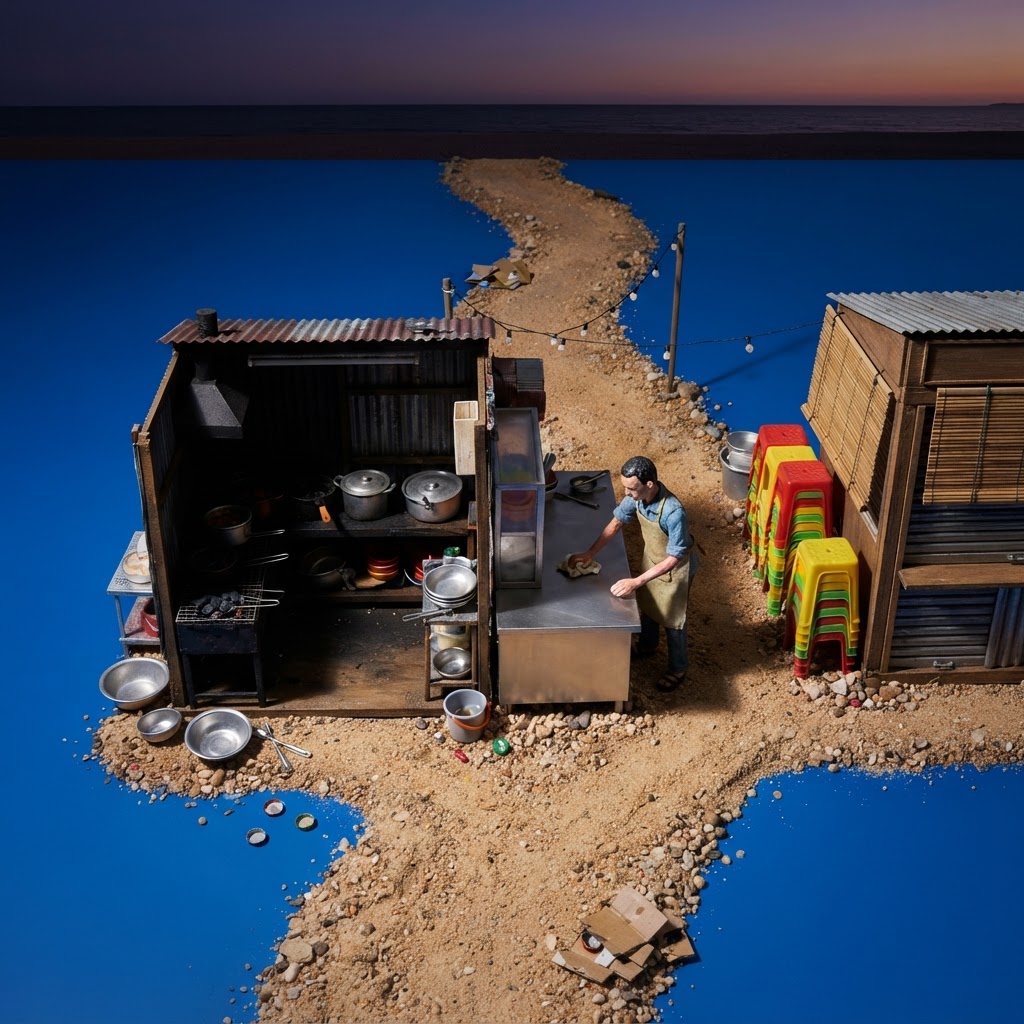
Walk through any tourist destination at the height of its season and the food economy looks unstoppable. Grills are full, delivery riders are stacked three deep outside resort gates, and every stall owner seems to be printing money. Then the season turns, the visitor numbers thin out, and the same kitchens that could not keep up with demand six weeks earlier are suddenly fighting to cover rent.
This is not a story about any one island or any one business. It is a structural problem that shows up wherever food entrepreneurship depends heavily on tourist traffic — Boracay-style beach economies, provincial festival towns, even urban strips that live off conference season. The businesses that survive long-term are not the ones that sell the most during peak. They are the ones that designed their kitchen, their staffing, and their menu for the whole year, not just the best weeks of it.
Filipino food entrepreneurs operating near tourism hubs, and increasingly those selling into tourist-adjacent online markets, are living this pattern right now. It is worth understanding clearly, because the mistakes are avoidable and the fixes are not expensive — they are structural.
The Island Economics of Appetite
Tourist demand for food is not steady demand. It is demand that arrives in waves, shaped by holidays, weather windows, school calendars, and travel sentiment that has nothing to do with how good your cooking is. A destination town can go from fully booked to half-empty within weeks, and the food businesses built around its foot traffic feel that swing immediately.
The mistake many food entrepreneurs make is treating the peak as the baseline. They look at the busiest month, calculate their average daily covers or orders from that window, and build their cost structure — staff count, ingredient volume, lease terms — around that number. It feels rational in the moment. It is also the single biggest reason food businesses in tourist economies collapse during the first real off-season they experience.
A kitchen sized for peak demand is a kitchen that bleeds money for the rest of the year.
The Kitchen Built for the Peak
Overbuilding shows up in three places: lease commitments, staffing, and equipment.
Lease terms negotiated during a boom period often lock in rates that only make sense if every month performs like the peak. Staffing follows the same trap — hiring a full peak-season crew on permanent contracts, then struggling to either pay them or let them go when volume drops. Equipment purchases, from extra refrigeration to a second grill station, get justified by peak-day numbers that may only happen a handful of weeks a year.
None of this is wrong on its own. The error is doing it without a plan for the other eight or nine months. A food business in a destination economy needs two operating models, not one: a peak-season configuration and a baseline configuration, with a clear, pre-decided trigger for switching between them. Waiting until the numbers drop to figure this out means making decisions under financial stress, which almost always produces worse outcomes — panic discounts, rushed layoffs, or quietly running at a loss while hoping the next season fixes everything.
The Perishable Problem
Food businesses carry a risk that most other small businesses don't: inventory that spoils. In island and resort economies, this risk compounds, because a large share of ingredients often has to travel in from outside the immediate area, adding both cost and timing risk to every order.
When demand is volatile, perishable inventory becomes a bet. Order for the peak and a slow week means throwing away stock. Order conservatively and a sudden surge means turning away paying customers or scrambling for last-minute, higher-cost sourcing. Either direction costs money.
The practical fix is building a flexible ingredient base rather than a fixed one. This means:
- Designing a core menu around ingredients with longer shelf life or local availability, so baseline operations don't depend on fragile supply chains.
- Reserving the most perishable, most tourist-driven dishes for a smaller, clearly peak-season menu that can be added or dropped without disrupting the core business.
- Building a relationship with more than one supplier for anything that has to come from outside the area, so a shipping delay or price spike doesn't shut down a dish entirely.
This is menu design functioning as risk management, not just as a customer experience decision.
Menu as a Financial Instrument
Most food entrepreneurs think of the menu as a creative or branding exercise. In a tourist-dependent market, it is better understood as a financial instrument — one that should be engineered to perform differently depending on who is walking through the door and what month it is.
Tourist-facing items can carry higher margins and more elaborate presentation, because tourist customers are, by nature, less price-anchored to the local market and more willing to pay for experience. Items aimed at the local, year-round customer base need a different logic entirely: tighter margins, faster turnover, and pricing that respects what residents actually pay for food day to day.
Trying to run one undifferentiated menu across both customer types usually fails both groups. It either overprices the business out of the local market or underprices the tourist-facing dishes relative to what visitors are actually willing to spend. A menu split by customer type and season, even informally, protects margin without requiring a full rebrand every few months.
Building a Business That Survives the Off-Season
The businesses that outlast tourism cycles almost always have a second revenue layer that does not depend on visitor traffic. This can take several forms, and the right one depends on what the kitchen already does well:
- Local catering and events. Weddings, office functions, and community gatherings don't disappear when tourist season ends, and they often pay more reliably.
- Packaged or preserved product lines. Sauces, baked goods, or ready-to-cook items extend the life of a kitchen's signature dishes beyond a single sitting and beyond a single season.
- Delivery and pre-order systems aimed at residents, not just visitors, which smooths out daily volume instead of leaving it entirely to foot traffic.
- B2B supply relationships, such as supplying smaller resorts, cafés, or retailers that need consistent product without running their own kitchen.
None of these need to be large. Their value is in the floor they create — a baseline of income that does not evaporate the moment the tourist season ends. A food business with even one of these layers in place enters the off-season with a plan instead of a prayer.
The Lesson Beyond the Beach
The specific pressures of a destination economy are easy to see because the swings are so visible — full one month, empty the next. But the underlying lesson applies to almost any food entrepreneur whose business leans on a predictable but temporary spike: fiesta season, exam season, graduation season, even the weekly payday rush that many small food sellers quietly depend on.
The question worth asking before expanding a menu, signing a longer lease, or hiring more staff is simple: does this decision make sense in the slowest month I will realistically face, not just the best one I've already seen? Food businesses rarely fail because the peak wasn't big enough. They fail because the rest of the calendar was never part of the plan.