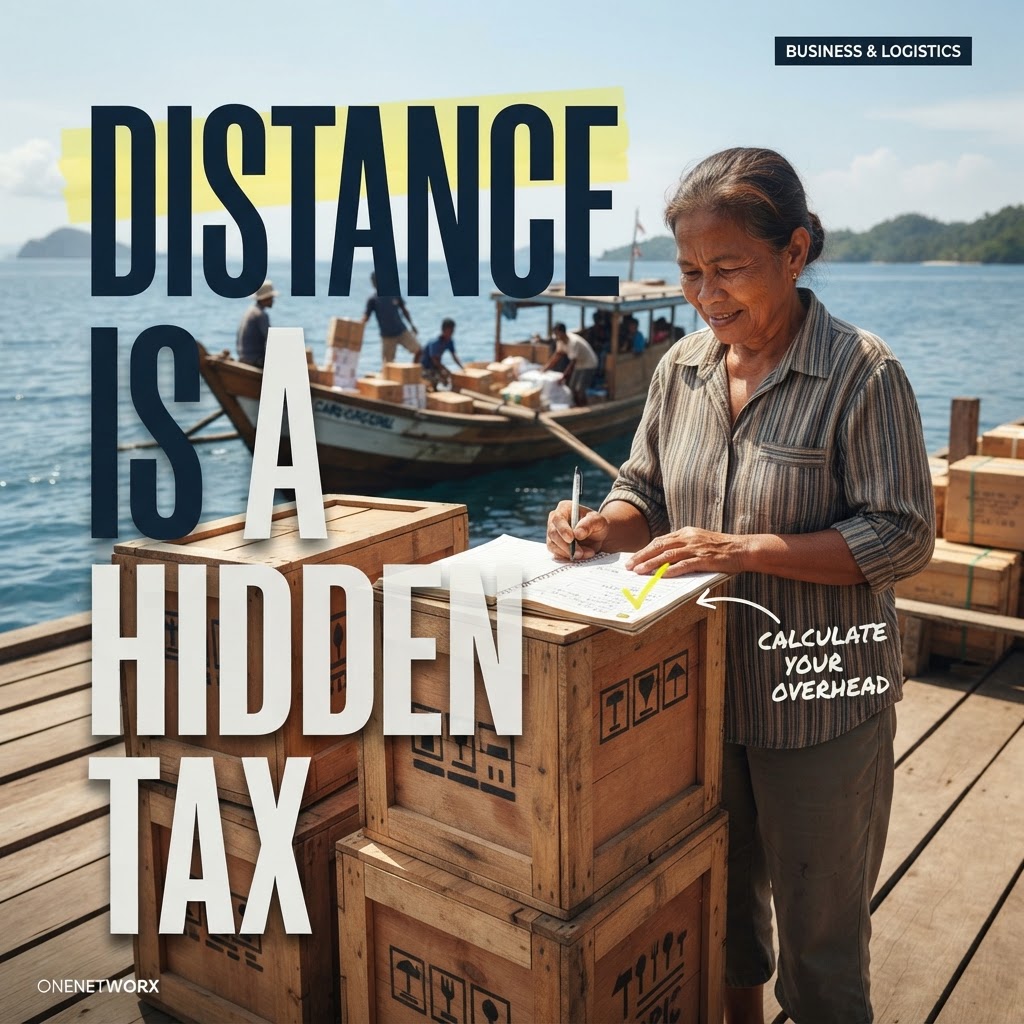
Every business owner learns, eventually, that location is never neutral. A shop in a dense urban district competes on foot traffic and rent. A business built around an island economy, a remote province, or a destination far from the country's main supply corridors competes with something else entirely: distance itself.
Think of a place like Palawan — a province whose economy leans heavily on movement of people and goods across water and air, where the nearest major wholesale market might be a plane ride or a multi-day barge trip away. The same arithmetic applies, in smaller or larger degrees, to any Filipino entrepreneur operating outside the dense supply corridors of Metro Manila or Cebu: a sari-sari store in a far-flung municipality, a boutique resort on a lesser-known island, a construction supplier serving a provincial capital.
The distance tax isn't a fee anyone invoices. It's the accumulated cost of freight, spoilage, delay, and risk that gets absorbed quietly into margins — usually without being named, measured, or priced for. Businesses that recognize it early build sturdier operations. Businesses that don't tend to discover it the hard way, usually during a supply disruption they didn't plan for.
The Hidden Line Item: Freight as a Fixed Cost, Not a Variable One
Most owners treat shipping and logistics as a variable cost — something that scales neatly with volume. In remote or island markets, it behaves more like a fixed cost with punishing floors. A shipment of ten units and a shipment of a hundred units might cost nearly the same to move, because the trip itself — the vessel, the trucking leg, the handling — has a baseline cost regardless of payload.
This changes the math of small-batch ordering. A business that orders conservatively to protect cash flow may be paying a freight premium per unit that a competitor ordering in volume never sees. The instinct to order small and often, which works well for urban businesses near their suppliers, can quietly erode margins for businesses further away.
The practical response isn't simply "order more." It's calculating freight as a true per-unit cost at different order sizes, and treating that calculation as a living part of pricing — not a one-time exercise done when the business launched.
Why Bulk Buying Isn't Always the Answer
The obvious counter to freight cost is to order in bulk and absorb the fixed logistics cost across more units. This works until storage, spoilage, and capital lockup start working against the same goal.
A remote business that over-orders perishable or trend-sensitive inventory to beat freight costs can end up with capital tied up in stock that degrades, goes out of season, or simply sits unsold while cash flow tightens elsewhere. The savings on freight get erased by losses on the inventory itself.
The better frame is matching order size to the actual shelf life and demand predictability of the product, not to the freight discount curve alone. Fast-moving, non-perishable goods can justify larger batches. Perishable or seasonal goods often can't — even if the per-unit freight math looks worse.
This is where many remote-market businesses underperform their urban counterparts: not because they buy wrong once, but because they never build a repeatable rule for deciding order size by product category rather than by gut feeling.
The Inventory Dilemma: Stockouts Cost More Than They Look
In a dense urban market, a stockout is usually a minor inconvenience — the customer walks next door or orders from an app. In a remote or island market, a stockout can mean a customer goes without the item entirely until the next supply run arrives, which might be weeks away.
This changes the real cost of running lean. A conservative inventory policy that looks financially prudent on a spreadsheet can quietly cost a business its most loyal customers, who stop treating it as reliable and start sourcing elsewhere — including, increasingly, through delivery platforms that didn't exist a decade ago and now reach even secondary towns.
Businesses operating far from their supply chain need a different buffer logic than businesses close to it. The safety stock that makes sense for a Metro Manila retailer is often dangerously thin for a provincial one, because the replenishment cycle is longer and less forgiving of surprises — a delayed shipment, a weather disruption, a supplier running short.
Pricing for Distance Without Pricing Out Your Customers
The instinct to simply mark up prices to cover distance costs runs into a real constraint: local customers often have less disposable income than the tourists or outside buyers the business may also be courting, and they notice unfair pricing quickly.
This is where many remote and destination-economy businesses end up running two effective pricing logics without fully admitting it — one price point implicitly built for visitors and transient demand, another that the regular, local customer base can sustain. The businesses that manage this well are explicit about it internally, structuring offers, bundles, or tiers rather than pretending a single price serves both markets equally.
The mistake to avoid is passing the full distance tax onto the local customer in a single undifferentiated price. It erodes the trust-based relationships that sustain a business through the off-season, when outside demand disappears and local loyalty is what keeps the lights on.
Building Supplier Relationships That Survive Distance
Proximity to suppliers creates a kind of slack that remote businesses don't have. An urban retailer who gets a bad batch or a late delivery can often resolve it same-day. A remote business dealing with the same problem may lose an entire selling cycle before a correction arrives.
This makes supplier relationship management a bigger strategic lever for remote businesses than for urban ones. Clear, documented expectations around lead times, minimum order adjustments during disruptions, and backup sourcing options matter more here, because there's less room to improvise when something goes wrong.
Some of the most resilient provincial and island businesses maintain a secondary supplier relationship they rarely use — not out of distrust, but as insurance against the single point of failure that distance creates. It costs a little in convenience and sometimes in price, but it protects against the scenario where one disrupted shipment stalls the entire business.
Treating Distance as a Design Constraint, Not a Disadvantage
The businesses that thrive in geographically remote or tourism-dependent markets tend to stop treating distance as an obstacle to apologize for and start treating it as a design constraint to build around — the same way a product designer treats a tight budget or a small physical space.
That shift in framing changes decisions concretely: inventory policy gets built around real replenishment cycles instead of urban norms. Pricing gets structured to reflect two distinct customer realities instead of one average. Supplier relationships get treated as critical infrastructure instead of a back-office detail.
None of this makes the distance tax disappear. It simply stops being an invisible cost that erodes margins quietly, and becomes a known variable the business has already priced, planned, and protected itself against.
That difference — between absorbing a cost you haven't named and managing a cost you have — is often what separates a remote-market business that survives its first rough season from one that doesn't see the next one coming.