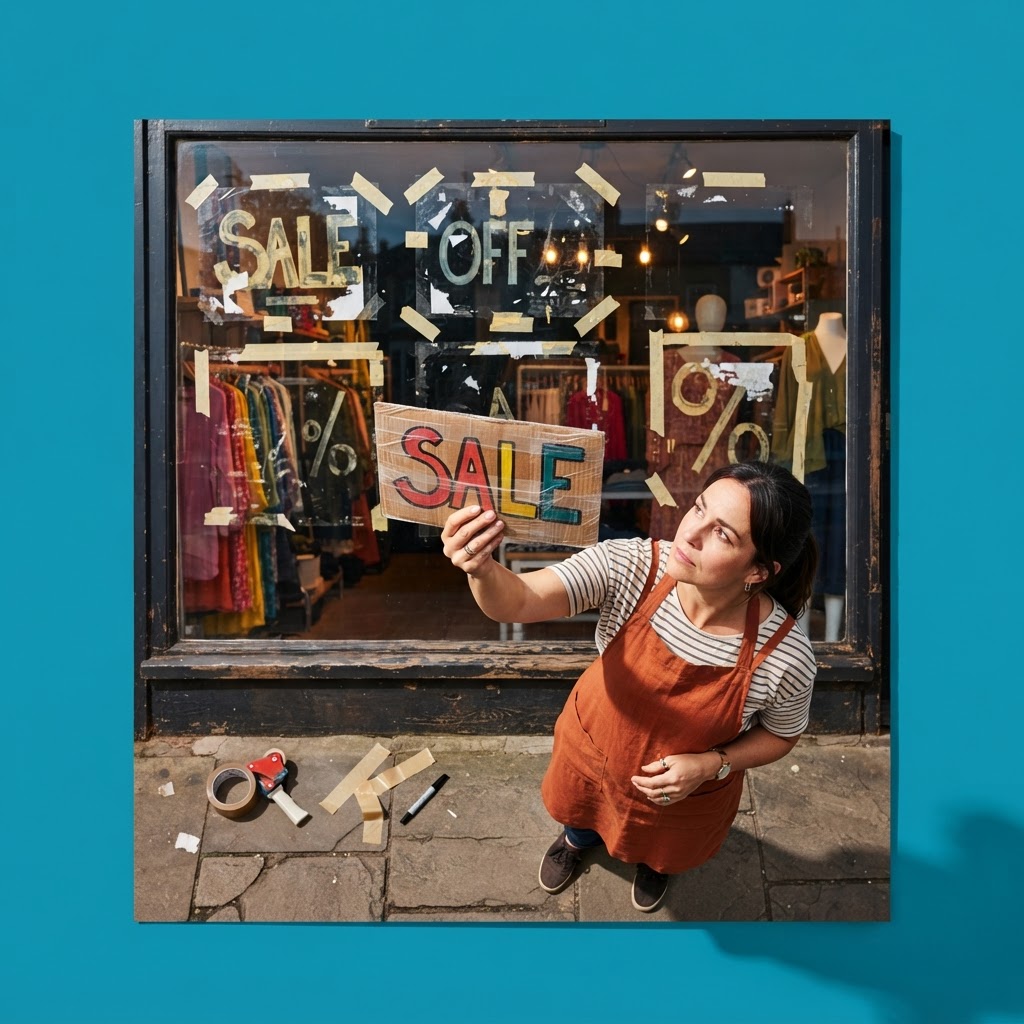
A slow week arrives. Sales dip, foot traffic thins out, and the instinct kicks in almost immediately: run a promo. Twenty percent off. Buy-one-take-one. Free delivery for orders today only. It feels like action. It feels like doing something about the problem.
For many small businesses, this has become less a strategy and more a reflex — a muscle memory response to any dip in demand. The trouble is that a reflex, repeated often enough, becomes a pattern the customer learns to anticipate. And once a customer learns your pattern, they stop responding to your full price at all.
This is not an argument against discounts. It's an argument for noticing what a discount is actually training your market to believe about your business.
The Habit Nobody Questions
Discounting is so normalized in small business culture that it rarely gets examined as a decision. It gets treated as a default lever — the first thing owners reach for when they want more orders, more bookings, more foot traffic.
Part of this comes from how visible and immediate discounting feels. A price cut produces an instant, countable result: more transactions this week. Compare that to something like improving product quality or tightening customer service, where the payoff is slower and harder to attribute. Discounting wins the comparison because it's measurable in the short term, even when it's quietly costing the business in the long term.
The other part is competitive anxiety. If a nearby business is running a promo, it feels risky not to match it. So discounting spreads sideways across an entire category — a strip of food stalls, a cluster of online sellers in the same niche, a street of salons — until almost nobody in that market is selling at full price anymore, and the baseline price has quietly shifted downward for everyone.
What a Discount Actually Communicates
A price is not just a number. It's a signal the customer uses to judge quality, scarcity, and how badly the business needs the sale. Every markdown adjusts that signal, whether the business intends it to or not.
A well-placed, occasional discount can signal generosity, gratitude, or a limited opportunity. A frequent, predictable discount signals something very different: that the listed price was never the real price to begin with.
Once a customer concludes that the sticker price is inflated padding waiting to be stripped away, they stop evaluating the product on its merits. They start evaluating the timing. The question shifts from "Is this worth it?" to "When will this go on sale again?" At that point, the business has lost control of its own pricing — not because a competitor took it, but because its own promotional habits handed it over.
This matters most for businesses trying to build a brand around quality, craftsmanship, or trust rather than around being the cheapest option in the category. A bakery known for artisanal bread, a tutor known for results, a boutique known for curation — these businesses erode their own positioning every time they discount reflexively, because the discount contradicts the story they're otherwise trying to tell.
The Customer You're Training
Consider what happens from the customer's side of a recurring promo cycle. The first time a discount shows up, it feels like a pleasant surprise. The second time, it feels like a pattern. By the third or fourth cycle, the customer has effectively been taught a rule: full price is for people who don't wait.
This produces a specific, predictable behavior — customers deliberately delaying purchases until the next markdown appears. Carts get abandoned not because the customer changed their mind, but because they're waiting for the price to drop. Bookings get postponed. Orders get held off until the familiar "sale" notification arrives.
The business, seeing softer sales between promos, often reads this as more evidence that discounting is necessary — not realizing it is looking at the consequence of its own training, not the cause. The slow weeks between discounts aren't proof that customers need another promo. They're proof that customers have learned to wait for one.
This pattern is especially visible in Philippine e-commerce and retail contexts, where flash sales, mega sale calendars, and salary-day promos have become deeply embedded in shopping behavior. For sellers who built their entire customer base around these events, the challenge later is that their buyers may never have formed a relationship with the business at all — only with the discount days. Remove the sale, and the loyalty disappears with it.
When a Discount Makes Sense — and When It's a Reflex
Not every discount is a mistake. The distinction worth making is between a discount with a clear strategic job and a discount used as a general-purpose fix for low sales.
A discount has a defensible job when it:
- Introduces a genuinely new customer to the business for the first time, with the goal of converting them to full-price later
- Clears specific aging inventory or perishable stock that is losing value anyway
- Rewards an existing, loyal customer in a way that deepens the relationship rather than just lowering the price
- Marks a real, limited occasion — an anniversary, a launch, a one-time event — rather than a recurring calendar fixture
A discount becomes a reflex when it is used simply because sales are soft, with no specific customer segment, inventory reason, or occasion behind it. The tell is usually in the language used internally: "let's just run a promo" rather than "let's target this specific group with this specific offer." Vague intent produces vague, habit-forming discounting. Specific intent produces discounts that do a job and then stop.
Protecting the Price Without Losing the Sale
Businesses that want to stay competitive without training customers to wait usually lean on alternatives that add value instead of subtracting price.
- Bundling rather than discounting. Pairing products or services together can increase perceived value without touching the price of any single item.
- Added service instead of lower price. Faster delivery, a small add-on, extended support, or a personal touch can satisfy the customer's desire for "more" without devaluing the core offer.
- Loyalty-based pricing that rewards repeat behavior specifically, rather than open promos available to everyone regardless of history.
- Tiered offers that let price-sensitive customers choose a smaller version of the product rather than pushing everyone toward a discounted version of the full one.
Each of these protects the integrity of the listed price while still giving the business a lever to pull when it needs to move volume.
Reading the Discount Back
Before running a promo, it's worth asking a short set of questions: What specific outcome is this discount supposed to produce? What will customers conclude about our regular price after seeing this? And would we be comfortable if this exact discount became the expectation going forward?
That last question tends to be the most honest one. Many businesses would not be comfortable with their current promo becoming permanent customer expectation — and yet that is exactly the trajectory a reflexive discount habit puts them on.
Price is one of the few things a small business fully controls, in a market where almost everything else — rent, supply costs, competition — is dictated from outside. Treating that control carelessly, by handing it over to a habit rather than a strategy, is an expensive way to chase a short-term bump in sales. The businesses that hold their pricing with intention aren't the ones refusing to ever discount. They're the ones who've decided, in advance, what a discount is for — and what it is not allowed to become.