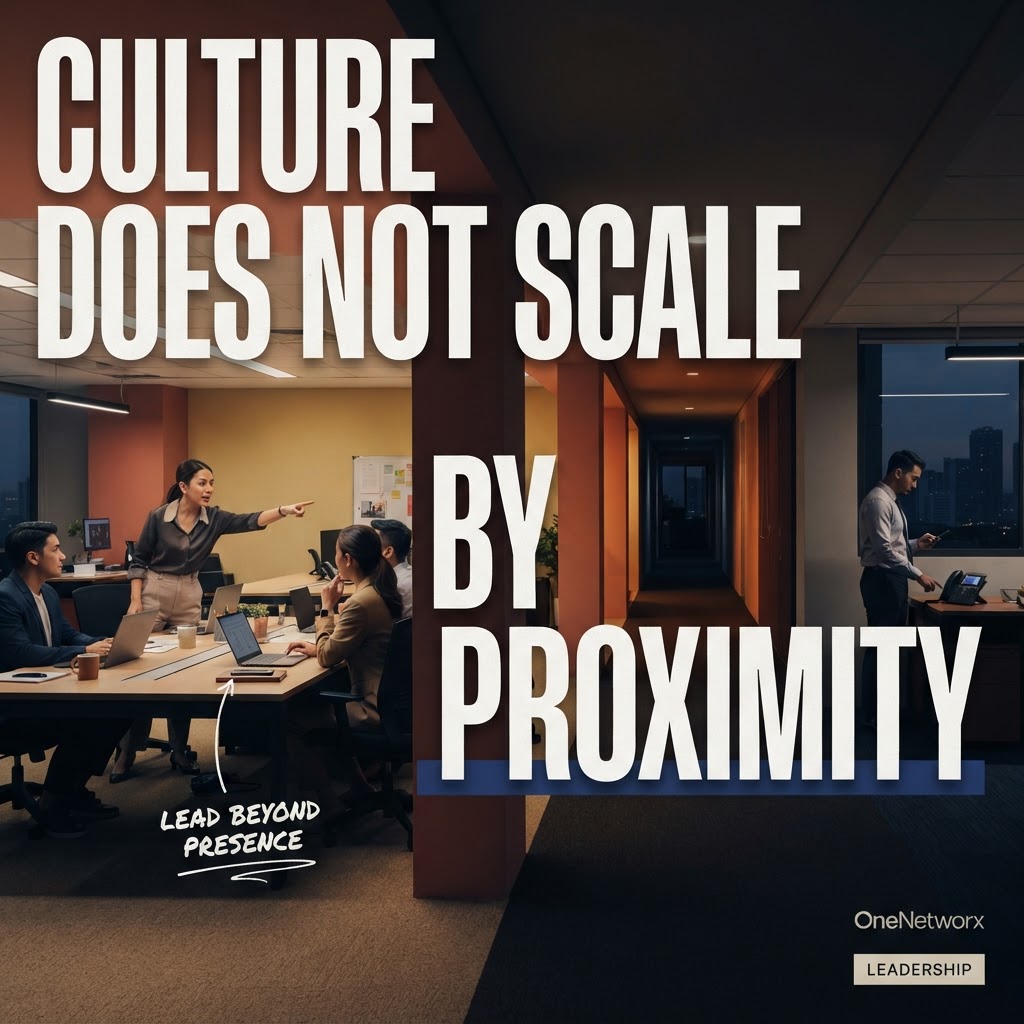
Every growing Philippine business eventually faces the same temptation: open a branch somewhere else. Lower overhead, a deep talent pool, proximity to a regional market, or simply room to expand beyond a crowded capital. Cities built around business process outsourcing, manufacturing, and conference-and-events infrastructure make an attractive case for stepping outside Metro Manila.
What rarely gets discussed is what happens to leadership when the owner, the senior managers, or the decision-makers stay behind.
Most founders assume leadership is portable — that the values, instincts, and judgment calls that work at headquarters will simply transfer to a new location through memos, video calls, and the occasional site visit. They don't. Leadership built on physical presence does not survive distance intact. It has to be rebuilt, deliberately, for a structure where the person in charge is not in the room.
The Hub-and-Satellite Illusion
When a business opens a second location, the mental model is usually "same company, new address." The org chart gets redrawn, a branch manager is appointed, and everyone assumes the existing culture and decision-making habits will carry over because the same company name is on the door.
This is the hub-and-satellite illusion: the belief that a satellite office inherits the hub's leadership simply by being connected to it administratively. In practice, a satellite office develops its own rhythm almost immediately. Local staff solve local problems the way that makes sense to them, not necessarily the way headquarters would. Within a few months, the branch has its own informal culture — sometimes better than the original, sometimes quietly worse — and leadership at headquarters often doesn't notice until something goes wrong.
The gap isn't about effort or distance in kilometers. It's that leadership, as most owners practice it, is reactive and situational. It responds to what's directly in front of it. When the branch is out of sight, it's also out of the leader's instinctive reach.
When the Decision Can't Wait for Headquarters
The clearest test of this gap is the moment a decision can't wait. A client complaint escalates. A supplier misses a delivery the branch depends on. A staff conflict needs resolving before it spreads. In a single-location business, the owner hears about it within the hour and acts. In a branch setup, the information travels through at least one layer before it reaches someone with real authority — and by the time it does, the moment for a clean, confident response has often passed.
This is where many branch structures quietly fail. Not through catastrophic mistakes, but through a steady accumulation of delayed, watered-down, or second-guessed decisions. The branch manager hesitates to act without approval. Headquarters hesitates to delegate real authority because they weren't there to see the context. Everyone waits for someone else to move first.
The fix isn't more reporting. More reporting usually just means more delay dressed up as diligence. The fix is deciding, in advance, which categories of decisions the branch leader is fully trusted to make without checking in — refunds under a certain threshold, staffing adjustments, minor vendor substitutions — and which ones genuinely need headquarters input. Most businesses never draw this line explicitly. They discover it, painfully, one crisis at a time.
Culture Doesn't Travel on Its Own
Culture is often described as "how we do things here," but the honest version is closer to "what gets rewarded and what gets ignored when the founder isn't watching." At headquarters, culture is enforced constantly and invisibly — through tone of voice in meetings, through who gets praised in passing, through small corrections nobody writes down. None of that transmits automatically to a new location.
A branch office left without deliberate cultural investment doesn't become a blank copy of headquarters. It becomes whatever its strongest local personality makes it. Sometimes that's a gift — a branch manager with good instincts can build something better than the original ever had. Sometimes it drifts toward whatever is easiest, which is rarely what the business needs.
Leaders who get this right treat culture-building as a separate project from operations, not a byproduct of it. They write down the specific behaviors that matter — how complaints get handled, how mistakes get discussed, what "good enough" actually means for this business — rather than assuming the branch will absorb these standards through proximity to the brand name. They also visit with intention, not just inspection. A site visit focused entirely on checking numbers teaches the branch that numbers are the only thing that matters.
The Trust Deficit No One Talks About
Underneath the operational gap sits a quieter problem: trust has to be engineered when it can't be assumed. In a single location, trust builds through daily observation — you see someone handle a difficult customer well, and your confidence in them grows without anyone saying a word. Across a distance, that organic trust-building mostly disappears, and what replaces it is often suspicion disguised as oversight.
This shows up as excessive approval chains, duplicate reporting, or a branch manager who is technically "in charge" but functionally powerless because every real decision still routes back to headquarters. The branch manager senses this and stops exercising judgment altogether, which then gets read by headquarters as proof that the branch "can't be trusted with more responsibility" — a self-fulfilling cycle that neither side usually recognizes they're caught in.
Breaking this cycle requires leadership to extend trust slightly ahead of where the evidence comfortably sits, then watch closely enough to adjust if it's misplaced. This feels uncomfortable to founders who built their business on hands-on control. It is also the only way a branch structure ever becomes genuinely self-sufficient rather than a permanent drain on headquarters' attention.
Building Leadership That Doesn't Need to Be in the Room
The businesses that handle this well tend to do three things differently.
First, they separate "leader" from "decision-maker on duty." The owner remains the leader, but someone physically present at the branch is given clear, named authority to act in specific situations without waiting for sign-off. This distinction matters more than most org charts admit.
Second, they build feedback loops that surface problems early rather than loops that simply report outcomes after the fact. A weekly five-minute check-in about what almost went wrong is worth more than a monthly report of what already did.
Third, they resist the urge to manage the branch through anxiety — constant check-ins driven by worry rather than structure. Frequent, unscheduled contact that only happens when something looks off teaches branch staff to hide problems rather than raise them. Scheduled, predictable touchpoints do the opposite.
None of this requires exotic management theory. It requires the founder to admit that the leadership style that worked when everyone fit in one room will not automatically scale to a second address — and to rebuild it on purpose rather than by accident.
What This Means for Growing Philippine Businesses
As more Philippine companies look beyond their home city for talent, cost advantages, or market access, the branch-office question will only become more common — not just for large corporations, but for small businesses that open a second shop, a second kitchen, or a second service hub somewhere else.
The operational logistics of expansion usually get planned carefully: leases, equipment, staffing budgets, local permits. Leadership rarely gets the same planning. It's assumed to just come along for the ride.
It doesn't. Leadership that depends on being physically present is leadership that stops at the office door. The owners who expand well are the ones who treat distance not as an inconvenience to manage around, but as a structural problem to design for — deciding in advance who gets to act, what trust looks like before it's earned, and how culture will travel when the founder isn't the one carrying it.