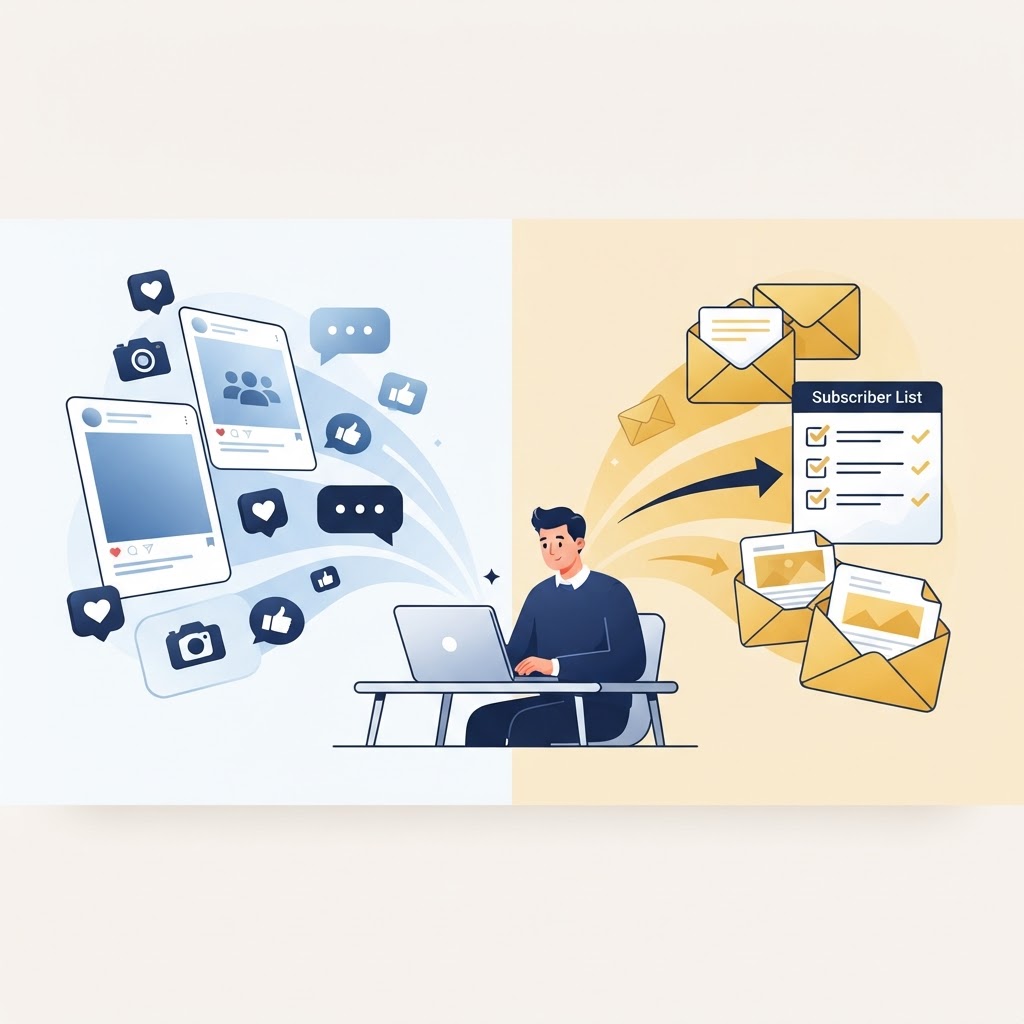
Most small businesses today live between two worlds: the fast-moving world of social media, and the quieter, more direct world of email.
Both are useful. But they do very different things — and understanding the difference can help a business use each one for what it does best.
This isn't an argument for abandoning social media. It's an argument for not depending on it alone.
What Social Media Does Well
Social media is, at its heart, a discovery channel. It's where people who don't know your business yet can find you.
It's useful for:
- Discovery — new audiences encounter your business through shares, search, and recommendations
- Visibility — a consistent presence helps people recognize your brand over time
- Conversations — questions, comments, and replies create back-and-forth
- Community — people with shared interests gather around a topic or brand
- Content distribution — it's an easy way to share what you create with a wide audience
What social media is not as good at is reliable, direct reach. A follower today isn't guaranteed to see your post tomorrow. The platform decides.
What Email Does Well
Email is different. When someone gives a business their email address, they've made a small, deliberate choice to hear from it. The business then has a direct line — one it manages itself.
Email is useful for:
- Direct communication — messages reach the subscriber's inbox, not a feed
- Newsletters — a consistent way to share useful information on a regular cadence
- Follow-up — continuing conversations with people who showed interest
- Nurturing — moving a relationship forward over time
- Recurring communication — a predictable rhythm the business controls
- Audience relationships — deeper, more personal than a public post
Email doesn't replace reach. It replaces reliability of reach — for the people who've already raised their hand.
What Your Website Does Well
There's a third piece that ties them together: the website.
A website is useful for:
- Information — what the business does, who it's for, how to get started
- Credibility — a home base people can trust and return to
- Conversion — where interest becomes action
- Products and services — the actual offerings, presented in full
The website is the destination. Social media points to it. Email brings people back to it.
How the Channels Work Together
The strongest approach usually isn't choosing one channel — it's using them together, each for its strength.
SOCIAL MEDIA Discovery ↓ WEBSITE Destination ↓ EMAIL Relationship ↓ CUSTOMER Ongoing engagement
Social media helps people find the business. The website gives them somewhere to land. Email keeps the relationship going — turning a one-time visitor into someone who comes back.
No single channel has to do all the work.
So Which Should Your Business "Own"?
Both — but in different ways.
You don't own your social media following in the strict sense; the platform controls distribution. You do own your email list: the addresses, the timing, and the messages.
That's why building an email list is often described as building an asset. It's a channel the business can rely on regardless of what changes on any social platform.
If you're just starting, a practical sequence looks like this:
- Use social media to be visible and helpful
- Point interested people to your website
- Offer a reason to subscribe on your website
- Use email to stay in touch
Each step supports the next.
Where an Email Marketing Platform Fits
At the very beginning, a business can collect a few addresses and send personal notes. As the list grows, doing it all manually gets harder — designing messages, managing subscribers, creating signup forms, setting up simple automation, and understanding what's working.
This is where an email marketing platform can help.
OneNetworx Recommended Partner: AWeber
OneNetworx recommends AWeber as one email marketing platform worth exploring for businesses, creators, and organizations that want to build and manage email communication.
AWeber provides tools that can support:
- Email creation
- Audience growth
- Signup forms
- Landing pages
- Automation
- Analytics
- Templates
- Integrations
It's one option among several. The right platform depends on your needs, budget, and how you plan to communicate.
The Short Version
Social media and email aren't rivals. They're partners.
Social media brings people in. Email keeps them close. The website gives both a home.
Use social media for discovery, your website for destination, and email for the relationship — and you won't be relying on any one channel to carry the whole business.
For a step-by-step starting point, see How to Start an Email List for Your Small Business. And once you have subscribers, What Should You Send to Your Email Subscribers? covers the practical next question.